Big Think
@bigthink·8.8M subscribers·10.1K videos
"Hey Bill Nye, Is Human Empathy an Evolutionary Advantage?" #tuesdayswithbill | Big Think
Posted
November 17, 2015
Views
62,318
Likes
1,885
Comments
231
Engagement
November 17, 2015
62,318
1,885
231
3.40%
Every word spoken in this episode is indexed. Type any phrase to jump straight to the moment it was said.
Type any word or phrase that may have been spoken. Click a result to seek the player to that exact moment.
Try a name, a topic, or a quoted line
See what was published immediately before and after this episode.
 3:45Now Playing
Is Human Empathy an Evolutionary Advantage?" #tuesdayswithbill
Watch the newest video from Big Think
Join Big Think Edge for exclusive videos
----------------------------------------------------------------------------------
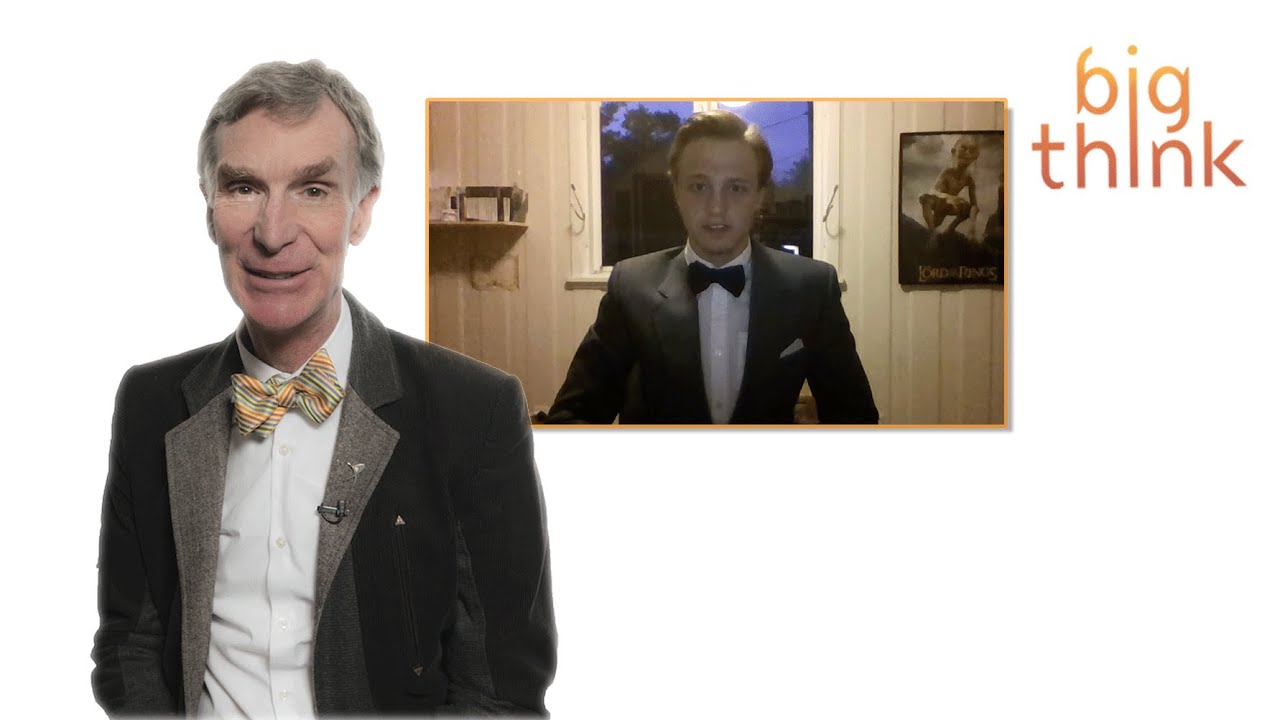
A dapper young Norwegian wants Bill Nye's perspective on human evolution. Not just the evolution of our shape and size, but also the evolution of human feelings. Nye takes an empirical perspective, examining the ways chimps and bonobos care for their young — and mourn the loss of their fellows. He concludes that human consciousness may not be as unique as we suppose and that animals may share our feelings, if not our ability to articulate them in language. Science is making progress in our understanding of human and animal emotion. A greater neurological understanding of how feelings exist in the brain could lead to a series of beneficial changes in society: new laws that are consistent with a scientific understanding of empathy and an artificial intelligence that is kinder and gentler than the crazed, maniacal versions we see in sci-fi films.
----------------------------------------------------------------------------------
BILL NYE, THE SCIENCE GUY:
Bill Nye, scientist, engineer, comedian, author, and inventor, is a man with a mission: to help foster a scientifically literate society, to help people everywhere understand and appreciate the science that makes our world work. Making science entertaining and accessible is something Bill has been doing most of his life. In Seattle Nye began to combine his love of science with his flair for comedy, when he won the Steve Martin look-alike contest and developed dual careers as an engineer by day and a stand-up comic by night. Nye then quit his day engineering day job and made the transition to a night job as a comedy writer and performer on Seattle's home-grown ensemble comedy show “Almost Live." This is where “Bill Nye the Science Guy®" was born. The show appeared before Saturday Night Live and later on Comedy Central, originating at KING-TV, Seattle's NBC affiliate. While working on the Science Guy show, Nye won seven national Emmy Awards for writing, performing, and producing. The show won 18 Emmys in five years. In between creating the shows, he wrote five children's books about science, including his latest title, “Bill Nye's Great Big Book of Tiny Germs." Nye is the host of three currently-running television series. “The 100 Greatest Discoveries" airs on the Science Channel. “The Eyes of Nye" airs on PBS stations across the country. Bill's latest project is hosting a show on Planet Green called “Stuff Happens." It's about environmentally responsible choices that consumers can make as they go about their day and their shopping. Also, you'll see Nye in his good-natured rivalry with his neighbor Ed Begley. They compete to see who can save the most energy and produce the smallest carbon footprint. Nye has 4,000 watts of solar power and a solar-boosted hot water system. There's also the low water use garden and underground watering system. It's fun for him; he's an engineer with an energy conservation hobby. Nye is currently the Executive Director of The Planetary Society, the world's largest space interest organization.
----------------------------------------------------------------------------------
TRANSCRIPT:
Trym: Hi Bill. This is Trym from Norway. I was wondering how come us humans have empathy? Is it normal for species to have empathy — I was just starting to read about Richard Dawkins' take on it. I was wondering how you would explain it? I love the way you explain things by the way. Thanks.
Bill Nye: You said your name with an accent that I will interpret Trym — I believe your name is? Trym, takk for your question. Thank you for your question. This is cool. So why are we empathetic? Just consider what a tribe of humans would be like without empathy, without ability to feel what someone else is feeling, without an ability to see it from another person’s point of view. It probably wouldn’t be a very successful tribe. You wouldn’t take care of each other. You probably wouldn’t divide up tasks. You do this and I’ll do that. I know that’s hard for you; I'll do this. I know you’re good at that, so you do that and I’ll do this. Imagine a tribe without empathy. So my claim, which is extraordinary at first, is not only are size and shape determined by a process of evolution, but so are our feelings. And empathy is part of that. Our ancestors without empathy were not as successful. And furthermore, while you’re on Richard Dawkins, look into primate behavior. Our ancestors — gorillas, bonobos, chimpanzees — they exhibit empathetic behavior..........
To read the transcript, please go to
To read the transcript, please go to
Sentinel Indexing in Progress
Metadata and chapters are available. Claim extraction for this episode is pending.
All video content is delivered via YouTube embedded players in accordance with the YouTube Terms of Service. Sentinel provides research tools that promote discovery and accountability across political media.