Big Think
@bigthink·8.8M subscribers·10.1K videos
Does Black Friday Shopping Keep Workers from Their Families? | C. Nicole Mason | Big Think
Posted
November 23, 2016
Views
13,223
Likes
253
Comments
162
Engagement
November 23, 2016
13,223
253
162
3.14%
Every word spoken in this episode is indexed. Type any phrase to jump straight to the moment it was said.
Type any word or phrase that may have been spoken. Click a result to seek the player to that exact moment.
Try a name, a topic, or a quoted line
 2:58Now Playing
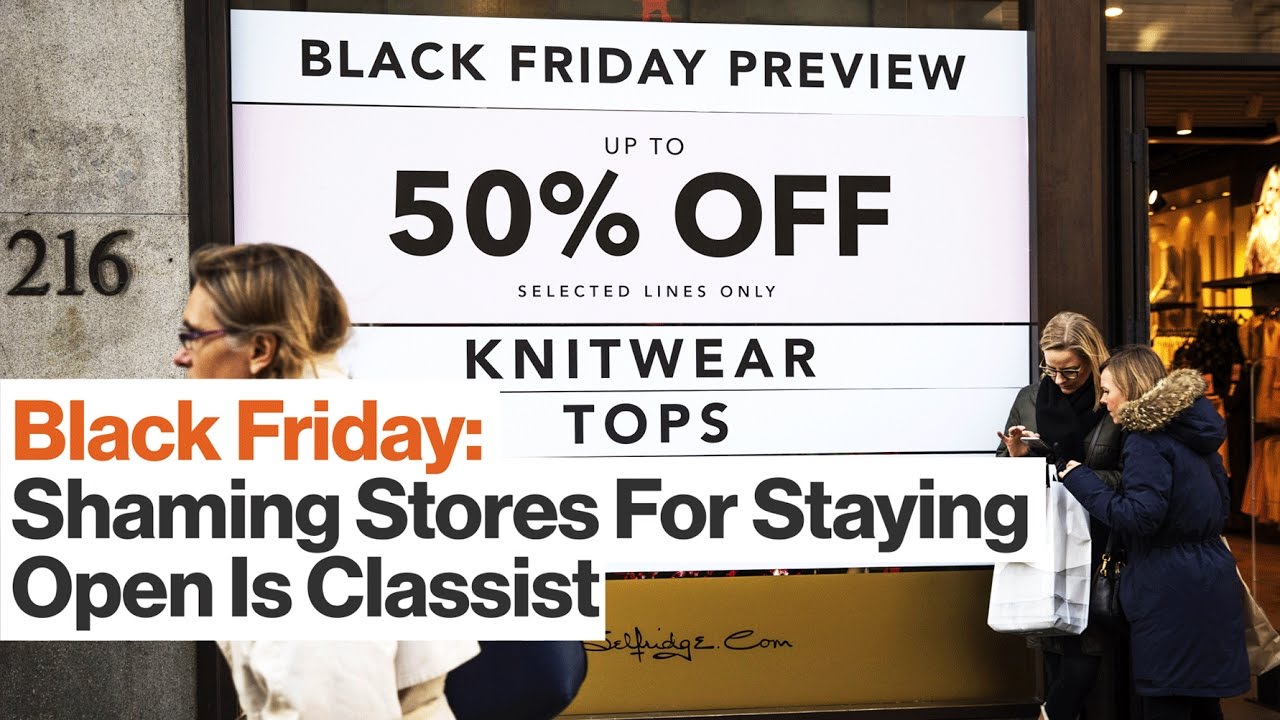
Does Black Friday Shopping Keep Workers from Their Families?
Watch the newest video from Big Think
Join Big Think Edge for exclusive videos
----------------------------------------------------------------------------------
Do big sales and shopping mania keep workers from their families the day after Thanksgiving? That's a common moral high ground, but it ignores the real needs of those on hourly wages.The irony of policies designed to tackle poverty is that their effects are visited least on those who actually make the rules. Politicians are not likely to feel the results of anti-poverty policies, nor are those who are primarily responsible for drafting legislation. As a result, it is easy for policy makers and opinion makers to take the moral high ground on positions pertaining to the role of money in life.
Black Friday — the day after Thanksgiving when shops offer big sales to ignite the holiday shopping season — is a case in point. It is easy to call Black Friday a commercial interruption, always occurring between a Thanksgiving Thursday and the weekend, that keeps workers from their family. What would otherwise be an extended weekend at home with loved ones becomes an obsession with new TVs, clothes, and other wares at bargain prices.
But such opinions fail to consider the economic reality of workers who live near the poverty line. Working on holidays, which provides overtime pay, may represent an economic opportunity. The chance to make time-and-a-half should not be dismissed by individuals who are more well off. Indeed taking the moral high ground without considering the needs of poor individuals is classist, says Dr. Nicole Mason.
Mason's book is Born Bright: A Young Girl's Journey from Nothing to Something in America.
----------------------------------------------------------------------------------
C. NICOLE MASON :
C. Nicole Mason is the author of Born Bright: A Young Girl’s Journey from Nothing to Something in America and heads up CR2PI at the New York Women’s Foundation. Her commentary and writing have been featured in the Los Angeles Times, The Chronicle of Higher Education, POLITICO, The Nation, The Progressive, Spotlight on Poverty, Marie Claire Magazine, USA Today, ESSENCE Magazine, The Huffington Post and on CNN, MSNBC, NPR, and NBC, among other outlets. Nicole is the Executive Director of the Center for Research and Policy in the Public Interest (CR2PI) at the New York Women’s Foundation. Nicole is also the creator of the Lead The Way Initiative for emerging women of color executive directors and mid-level managers working in the social sector. Since it’s inception, more than 100 leaders have cycled through the program including a Presidential Appointee and a MacArthur Foundation Genius.
For more than two decades, Nicole has worked on a range of pressing social issues from violence against women to reproductive justice to economic security. She is also the former Executive Director of the Women of Color Policy Network at New York University’s Robert F. Wagner Graduate School of Public Service. There, she held the distinction of being one of the youngest scholar-practitioners to lead a major U.S. research center or think tank. Under her direction, the Network became a leading authority and voice on public policies impacting women of color, low-income families and communities of color. Nicole is also an Inaugural Ascend Fellow at the Aspen Institute, a Patricia Roberts Public Policy Fellow and received the Dillon Award in American Politics. Nicole lives between Brooklyn, New York and Washington, DC and is mom to twins Charli and Parker and two dogs, Anderson & Sofia.
----------------------------------------------------------------------------------
TRANSCRIPT :
C. Nicole Mason: One of the things that really, really upsets me – a lot of things upset me but this upsets me – is that the people who are talking about poverty and what should be done are the people who are not or are least likely to be affected. So we’re talking about policymakers. We’re talking about, you know, my colleagues – middle class people who are not worrying about, you know, their lack of healthcare, health insurance. They’re not wage earners. I mean hourly wage earners. So I’m, you know, so I feel like I’m also living in a bubble, right. So I live a very comfortable life, you know, in a great neighborhood, great schools. All the things that I talk about in terms of what works.And so what that means is that I also hear what people are saying, right. So the conversation is oh, you know, it’s so bad. Why are people, you know, Walmart, Target, Best Buy, whatever store – close down for, you know, don’t open on those days, right. You know you’re horrible, you’re screwed, you’re this, that and the other.
Read the full transcript at
Sentinel Indexing in Progress
Metadata and chapters are available. Claim extraction for this episode is pending.
All video content is delivered via YouTube embedded players in accordance with the YouTube Terms of Service. Sentinel provides research tools that promote discovery and accountability across political media.