Bloomberg Podcasts
@bloombergpodcasts·503K subscribers·32.4K videos
Samsung to Make Tesla AI Chips in a $16.5 Billion Deal
Posted
July 28, 2025
Views
3,240
Likes
44
Comments
11
Engagement
1.70%
July 28, 2025
3,240
44
11
1.70%
Every word spoken in this episode is indexed. Type any phrase to jump straight to the moment it was said.
Type any word or phrase that may have been spoken. Click a result to seek the player to that exact moment.
Try a name, a topic, or a quoted line
See what was published immediately before and after this episode.
 3:40Now Playing
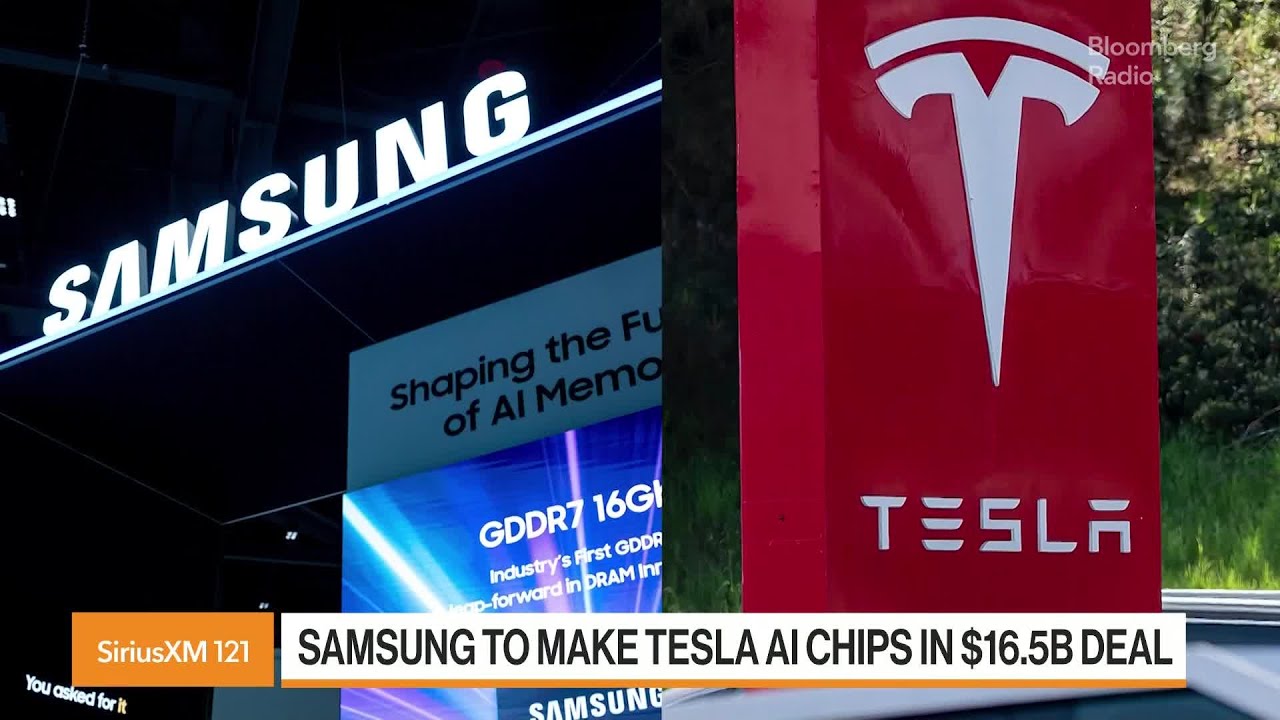
- Samsung will produce AI semiconductors for Tesla Inc. in a new $16.5 billion pact that marks a win for its underperforming foundry division.
South Korea’s largest company announced on Monday that it secured the 22.8 trillion won chipmaking agreement, which will run through the end of 2033. The plan is for an upcoming plant in Taylor, Texas, to produce Tesla’s next-generation AI6 chip, Tesla chief Elon Musk said on X, confirming a Bloomberg News report.
A Samsung spokesperson declined to comment, citing confidentiality terms in its contract.
“The strategic importance of this is hard to overstate,” Musk, 54, wrote on X. He described the value of the deal announced by Samsung as “just the bare minimum. Actual output is likely to be several times higher.”
Bloomberg's Craig Trudell reports.
The Tesla chief executive officer and X owner will walk the chip fabrication line himself and has been authorized by Samsung to assist in optimizing production, he said. The AI6 component will form the foundation of Tesla’s driving hardware suite for cars in coming years. Samsung produces the current AI4 system, according to Musk.
The contract win, the first after Executive Chairman Jay Y. Lee was cleared of all outstanding legal charges, comes as Samsung has been steadily losing ground in chip manufacturing. The company, which makes its own memory chips and also fabricates semiconductors on behalf of clients, has had difficulty bringing in enough orders to fully utilize its foundry capacity. It has postponed completion of construction and operational ramp-up of its new Texas fab to 2026.
“Their foundry business has been loss-making and struggling with under-utilization, so this will help a lot,” said Vey-Sern Ling, managing director at Union Bancaire Privee in Singapore. “Tesla’s business may also help them to attract other customers.”
That’s in contrast to leading chipmaker Taiwan Semiconductor Manufacturing Co., which still cannot meet all demand. TSMC held a dominant share of 67.6% of the global foundry market in the first quarter this year, according to Taipei-based TrendForce. Samsung’s share slipped to 7.7% from 8.1% in the previous quarter.
Samsung and TSMC are both on pace to deliver the next generation of semiconductor advancement — moving to 2-nanometer fabrication — and the new deal is seen as a signal of confidence for the company’s upcoming fabrication technology.
While the contract may represent a small share of foundry revenue annually, it holds greater value as a catalyst for technological refinement and innovation over the long run, according to Ryu Young-ho, an analyst at NH Investment & Securities Co. It also helps burnish Samsung’s reputation as the strongest alternative to TSMC at a time when Intel Corp. is struggling to win over investors skeptical about its long-term strategy and road map.
Samsung is expanding production in Texas with support from the 2022 Chips Act and Science Act, Washington’s effort to rebuild the American semiconductor industry with $39 billion in grant funding and billions more in tax breaks and other incentives. The Korean company signed an agreement for as much as $4.75 billion in funding and tax credits that could top $9 billion.
While President Donald Trump and his administration originally criticized the legislation, they have reversed course and used it to press companies like TSMC and Samsung for additional investments in the US. For Tesla, buying components produced in the US would allow it to avoid any chip tariffs, which the new administration has considered.
Musk has said Tesla’s future will depend on delivering the long-elusive goal of true self-driving technology. Last week, after a disappointing earnings report, he said the automaker will face “a few rough quarters” until it can deliver autonomous vehicles at scale — which he predicted for the second half of 2026 or by the end of the year.
--------
Watch Bloomberg Radio LIVE on YouTube
Weekdays 7am-6pm ET
Follow us on X
Subscribe to our Podcasts:
Bloomberg Daybreak
Bloomberg Surveillance
Bloomberg Intelligence
Balance of Power
Bloomberg Businessweek
Listen on Apple CarPlay and Android Auto with the Bloomberg Business app:
Apple CarPlay
Android Auto
Visit our YouTube channels:
Bloomberg Podcasts
Bloomberg Television
Bloomberg Originals
Sentinel Indexing in Progress
Metadata and chapters are available. Claim extraction for this episode is pending.
All video content is delivered via YouTube embedded players in accordance with the YouTube Terms of Service. Sentinel provides research tools that promote discovery and accountability across political media.