Bloomberg Podcasts
@bloombergpodcasts·503K subscribers·32.4K videos
Fed's Miran Said Trump Hasn't Asked Him to Set Policy in Specific Way
Posted
September 22, 2025
Views
629
Likes
7
Comments
3
Engagement
September 22, 2025
629
7
3
1.59%
Every word spoken in this episode is indexed. Type any phrase to jump straight to the moment it was said.
Type any word or phrase that may have been spoken. Click a result to seek the player to that exact moment.
Try a name, a topic, or a quoted line
 5:44Now Playing
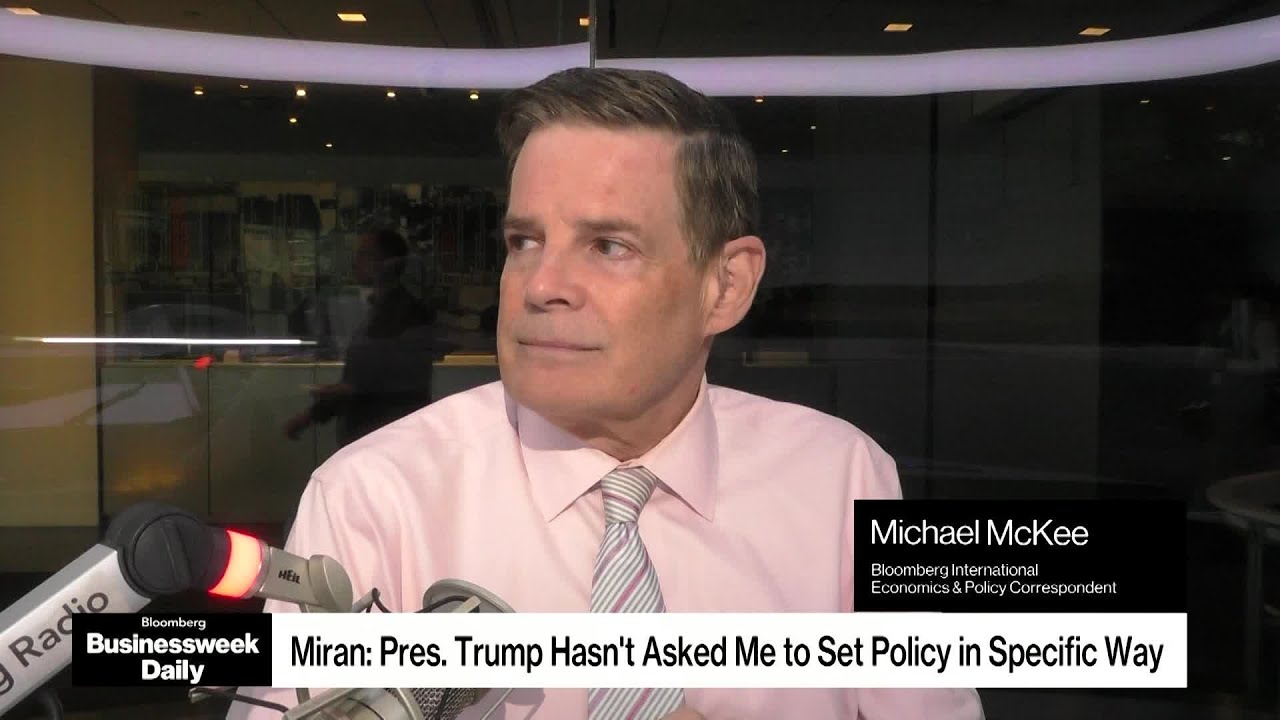
Bloomberg's Mike McKee breaks down comments by newly appointed Federal Reserve governor Stephen Miran, who told Bloomberg's Saleha Mohsin during an interview at the Economic Club of New York that President Trump had not asked him to take specific policy stances.
The Federal Reserve’s newest policymaker, appointed by President Donald Trump, laid out his argument for aggressively lowering interest rates on Monday, presenting a view that aligns with the president’s demands but which makes him an outlier at the central bank.
In his first policy speech since joining the Fed, Governor Stephen Miran argued that the neutral rate of interest — where the policy rate neither stimulates nor weighs on the economy — has been pushed lower this year by tariffs, immigration restrictions and tax policy.
That means interest rates should be much lower to prevent damaging the economy, he said.
“The upshot is that monetary policy is well into restrictive territory,” Miran said Monday in prepared remarks for an event at the Economic Club of New York. “Leaving short-term interest rates roughly 2 percentage points too tight risks unnecessary layoffs and higher unemployment.”
Miran participated in last week’s Federal Open Market Committee meeting, where policymakers lowered interest rates by a quarter percentage point for the first time since December, to a range of 4-4.25%. Miran dissented, preferring instead to lower rates by a half percentage point.
Until his appointment to the Fed, Miran served as chair of the White House Council of Economic Advisers. He didn’t resign from that post but is taking an unpaid leave of absence. His term as governor expires at the end of January, though it’s unclear how long he might stay.
Miran indicated in rate projections released last week that he preferred to cut rates by a total of 1.5 percentage points this year. Since his estimate of the neutral rate is so low, it would be better, he argued, to move toward it more quickly.
By contrast, the median projection of the Fed’s 19 officials has them lowering rates by another half percentage point.
“It’s not a panic — a panicky move would be something like 75 basis points or more,” Miran said in a question-and-answer session following his speech. “I’m not panicked, I just see that the risks grow the longer you remain significantly above neutral.”
Miran added he’d likely continue to dissent at future Fed meetings.
“Until my view changes, I will continue arguing for that view and if that means continuing to dissent, that means continuing to dissent,” Miran said. “I’m not going to vote for something I don’t believe in just for the sake for creating an illusion of consensus where there is none.”
Initial reaction to Miran’s speech was skeptical.
“I’m having a hard time buying the idea that Fed policy right now is evenly mildly restrictive,” said Joe Brusuelas, chief economist at RSM. Financial conditions, he added, are accommodative and the labor market remains near full employment — neither of which supports the idea that rates are highly restrictive.
Falling Neutral
Miran outlined several ways in which he believes the neutral rate of interest is lower now. A sharp decrease in immigration, revenue from tariffs and increased economic growth from this year’s tax legislation should all press that rate lower, he said.
“In my view, insufficiently accounting for the strong downward pressure on the neutral rate resulting from changes in border and fiscal policies is leading some to believe policy is less restrictive than it actually is,” he said.
Some policies, like lifting regulations — which he said are a “material impediment to growth —” might boost the neutral rate, but fiscal policies are likely more significantly lowering the neutral rate, Miran said.
His estimate of neutral, around 2.5%, is now much lower than the median Fed official’s projection of 3%, though several other policymakers also project that the neutral rate is under 3%. Still, Miran is the only one calling for getting there quickly.
--------
Watch Bloomberg Radio LIVE on YouTube
Weekdays 7am-6pm ET
Follow us on X
Subscribe to our Podcasts:
Bloomberg Daybreak
Bloomberg Surveillance
Bloomberg Intelligence
Balance of Power
Bloomberg Businessweek
Listen on Apple CarPlay and Android Auto with the Bloomberg Business app:
Apple CarPlay
Android Auto
Visit our YouTube channels:
Bloomberg Podcasts
Bloomberg Television
Bloomberg Originals
Sentinel Indexing in Progress
Metadata and chapters are available. Claim extraction for this episode is pending.
All video content is delivered via YouTube embedded players in accordance with the YouTube Terms of Service. Sentinel provides research tools that promote discovery and accountability across political media.