Bloomberg Podcasts
@bloombergpodcasts·503K subscribers·32.4K videos
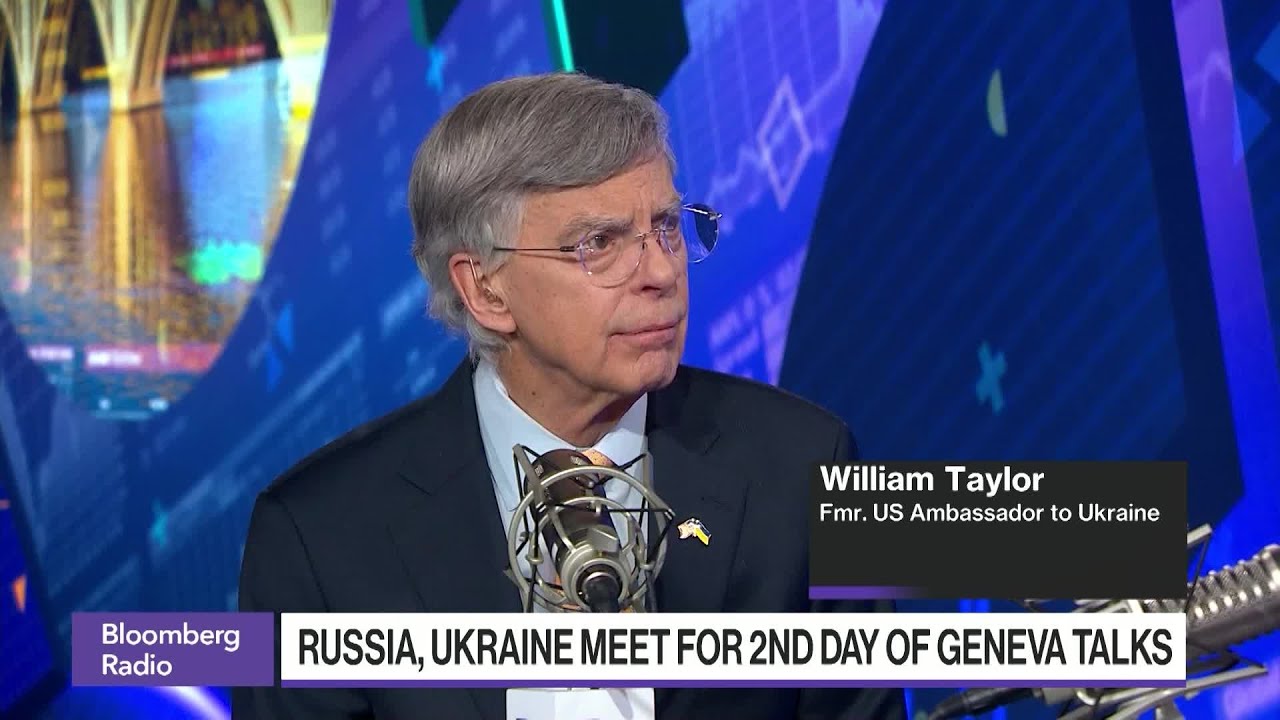
Putin Dragging Out Talks In Hopes of Tiring Allies Support for Ukraine, Says William Taylor
Posted
February 18, 2026
Views
1,968
Likes
42
Comments
17
Engagement
February 18, 2026
1,968
42
17
3.00%
Every word spoken in this episode is indexed. Type any phrase to jump straight to the moment it was said.
Type any word or phrase that may have been spoken. Click a result to seek the player to that exact moment.
Try a name, a topic, or a quoted line
 9:03Now Playing
Former US Ambassador to Ukraine William Taylor said Russian President Vladimir Putin is dragging out negotiations, hoping that Ukraine will get worn down by the grind of the war and that the US will lose interest. Taylor said despite Russia's intentions to prolong the war, Ukraine or its European allies are unlikely to give up.
A second day of US-brokered meetings in Geneva between Russia and Ukraine broke up after barely 90 minutes as Ukrainian President Volodymyr Zelenskiy accused Moscow of attempting to prolong the process.
The talks were difficult and businesslike, the head of Russia’s delegation Vladimir Medinsky said on Wednesday, adding the next meeting will take place soon without specifying when.
“This is complex work that requires alignment among all parties and sufficient time. There is progress, but no details can be disclosed at this stage,” National Security and Defense Council Secretary Rustem Umerov, the head of Ukraine’s delegation, told reporters in Geneva after the talks ended. The next step is to reach enough consensus to put decisions in front of the presidents, he said. He left without taking any questions.
Zelenskiy said that he expected a detailed report following the meetings from his team, but in an earlier post on X accused Moscow of stalling. “Russia is trying to drag out negotiations that could already have reached the final stage,” he said on Wednesday. He later told reporters that all sides agreed the monitoring of any potential ceasefire would involve the US, which he called “a constructive signal,” but said political will was still needed to end Russia’s full-scale invasion.
Medinsky later held a closed-door meeting with Ukrainian representatives after the official round of talks, the BBC’s Russian service reported. Nearly four years after Vladimir Putin’s full-scale invasion of Ukraine, the war’s toll is measured not only in the shattered cities across the border but increasingly in Russia’s own frontier regions.
Millions of Ukrainians are enduring one of the coldest winters in recent memory without reliable electricity and heating as waves of Russian missile and drone attacks have devastated energy infrastructure. Tens of thousands of Russians living along the country’s western edge are facing similar hardships now, as cross-border strikes damage essential utilities, forcing authorities to adopt emergency measures.
Belgorod, a regional capital about 40 kilometers from Ukraine, has become the most visible illustration of the growing domestic cost of the Kremlin’s war. The city of about 322,000 people is grappling with extensive damage to its energy network following Ukrainian missile attacks, with the destruction severe enou In a conflict the Kremlin has framed as distant from the lives of ordinary Russians, the experience of Belgorod and other border regions underscores how the front line has edged closer to home — bringing with it the same risks to energy systems, public services and civilian life that have defined the war on a far greater scale inside Ukraine since 2022.
Even as those regions teeter on the brink of a humanitarian emergency, top officials and state media in Moscow play down the consequences of Putin’s war on Russian soil. The president doesn’t address the plight of border communities, which gets scant mention at government meetings and is largely absent from coverage on national television channels.
Information about the scale of the damage comes primarily from regional authorities, which disclose details only intermittently. And nobody levels criticism at Putin for bringing war to their doors.
In Belgorod, Governor Vyacheslav Gladkov said restoring hot water supplies to homes connected to the region’s centralized heating system likely won’t be possible for the rest of the winter heating season. Temperatures are currently ranging as low as minus 10C (14F) in the city.
Gladkov reported last week that around 80,000 residents were left without heating following attacks, roughly 3,000 were without gas supplies and about 1,000 had no electricity.
--------
Watch Bloomberg Radio LIVE on YouTube
Weekdays 7am-6pm ET
Follow us on X
Subscribe to our Podcasts:
Bloomberg Daybreak
Bloomberg Surveillance
Bloomberg Intelligence
Balance of Power
Bloomberg Businessweek
Listen on Apple CarPlay and Android Auto with the Bloomberg Business app:
Apple CarPlay
Android Auto
Visit our YouTube channels:
Bloomberg Podcasts
Bloomberg Television
Bloomberg Originals
Sentinel Indexing in Progress
Metadata and chapters are available. Claim extraction for this episode is pending.
All video content is delivered via YouTube embedded players in accordance with the YouTube Terms of Service. Sentinel provides research tools that promote discovery and accountability across political media.