Bloomberg Podcasts
@bloombergpodcasts·503K subscribers·32.4K videos
US Supreme Court Strikes Down Trump's Global Tariffs
Posted
February 20, 2026
Views
10,467
Likes
199
Comments
63
Engagement
February 20, 2026
10,467
199
63
2.50%
Every word spoken in this episode is indexed. Type any phrase to jump straight to the moment it was said.
Type any word or phrase that may have been spoken. Click a result to seek the player to that exact moment.
Try a name, a topic, or a quoted line
 6:56Now Playing
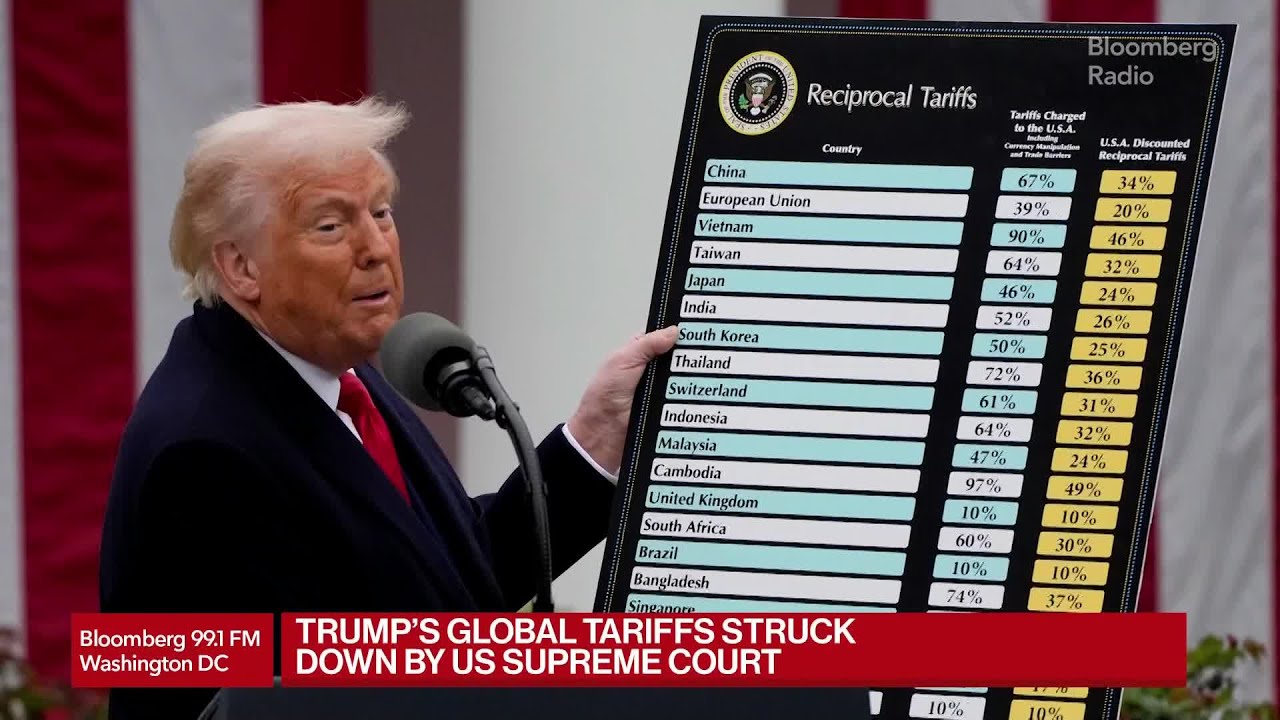
Tyler Kendall, Bloomberg News Washington Correspondent, discusses the US Supreme Court's decision on President Trump's global tariffs.
The US Supreme Court struck down President Donald Trump’s sweeping global tariffs, undercutting his signature economic policy and delivering his biggest legal defeat since he returned to the White House.
Voting 6-3, the court said Trump exceeded his authority by invoking a federal emergency-powers law to impose his “reciprocal” tariffs across the globe as well as targeted import taxes the administration says address fentanyl trafficking.
The justices didn’t address the extent to which importers are entitled to refunds, leaving it to a lower court to sort out those issues. If fully allowed, refunds could total as much as $170 billion - more than half the total revenue Trump’s tariffs have brought in.
The White House has said it will quickly replace the levies using other legal tools, though the fall-back options tend to be either more cumbersome or more limited than the wide-ranging powers Trump asserted under the International Emergency Economic Powers Act.
Read More: Trump’s Options After Supreme Court Said His Tariffs Are Illegal
Stocks rose on news of the decision given investors previously fretted tariffs would hurt the outlook for economic growth and company earnings. But Treasuries fell on the potential loss of tax revenues and the dollar also dipped because of the likely relief to other economies.
The ruling strikes at the heart of Trump’s agenda, blunting an all-purpose cudgel he has enthusiastically wielded against trading partners. Trump this month set up a process to impose tariffs as high as 25% on goods from countries doing business with Iran. He previously threatened to impose tariffs on European countries resisting his attempt to take over Greenland.
The decision could cut the US average effective tariff rate by more than half. A Bloomberg Economics analysis before the ruling concluded that a broad decision against Trump would reduce the rate from 13.6% to 6.5%, a level not seen since March.
The high court majority said the 1997 law doesn’t authorize tariffs. IEEPA, as the law is known, gives the president a panoply of tools to address national security, foreign policy and economic emergencies but doesn’t explicitly mention tariffs or taxes.
“When Congress grants the power to impose tariffs, it does so clearly and with careful constraints,” Chief Justice John Roberts wrote in the court’s majority opinion. “It did neither here.”
Two Trump appointees — Justices Neil Gorsuch and Amy Coney Barrett — joined Roberts and the court’s three liberals in the majority. Justices Brett Kavanaugh, Clarence Thomas and Samuel Alito dissented.
Kavanaugh wrote that the refund process was “likely to be a ‘mess,’ as was acknowledged at oral argument.”
Trump has called tariffs “my favorite word” and vowed they will “make us rich as hell.”
The case is Learning Resources v. Trump, 24-1287.
--------
Watch Bloomberg Radio LIVE on YouTube
Weekdays 7am-6pm ET
Follow us on X
Subscribe to our Podcasts:
Bloomberg Daybreak
Bloomberg Surveillance
Bloomberg Intelligence
Balance of Power
Bloomberg Businessweek
Listen on Apple CarPlay and Android Auto with the Bloomberg Business app:
Apple CarPlay
Android Auto
Visit our YouTube channels:
Bloomberg Podcasts
Bloomberg Television
Bloomberg Originals
Sentinel Indexing in Progress
Metadata and chapters are available. Claim extraction for this episode is pending.
All video content is delivered via YouTube embedded players in accordance with the YouTube Terms of Service. Sentinel provides research tools that promote discovery and accountability across political media.