Bloomberg Podcasts
@bloombergpodcasts·503K subscribers·32.4K videos
Troops in MidEast Give US Options, Leverage in Talks, Says Ret. Maj. Gen. Robeson
Posted
March 30, 2026
Views
1,039
Likes
12
Comments
8
Engagement
March 30, 2026
1,039
12
8
1.92%
Every word spoken in this episode is indexed. Type any phrase to jump straight to the moment it was said.
Type any word or phrase that may have been spoken. Click a result to seek the player to that exact moment.
Try a name, a topic, or a quoted line
 11:02Now Playing
Retired Marine Corps Major General Mastin Robeson said that increased troops sent to the MidEast means that the US has 'positioned sufficient assets' to be able to enact leverage over negotiations to open the Strait of Hormuz and end the war with Iran. Robeson also discussed how the war has impacted the US relationship with China, as Xi moves to invite Taiwan's opposition leader for a meeting ahead of the scheduled Trump, Xi meeting in May.
US President Donald Trump repeated threats to destroy Iranian energy assets if the Strait of Hormuz isn’t reopened soon, raising fears the war could escalate after more American troops arrived in the region.
The US “is in serious discussions” with what he called a new regime in Iran to end military operations, Trump said in a social-media post on Monday. But if a deal isn’t reached and Hormuz reopened, “we will conclude our lovely “stay” in Iran by blowing up and completely obliterating all of their Electric Generating Plants, Oil Wells and Kharg Island (and possibly all desalinization plants!).”
Trump has regularly vacillated between saying a deal with Iran is imminent and warning he’s prepared to up the military tempo, though in this case the threat to water facilities would constitute a war crime as defined by the Geneva Conventions.
Iran has consistently said peace talks aren’t progressing and has signaled it can carry on fighting for much longer.
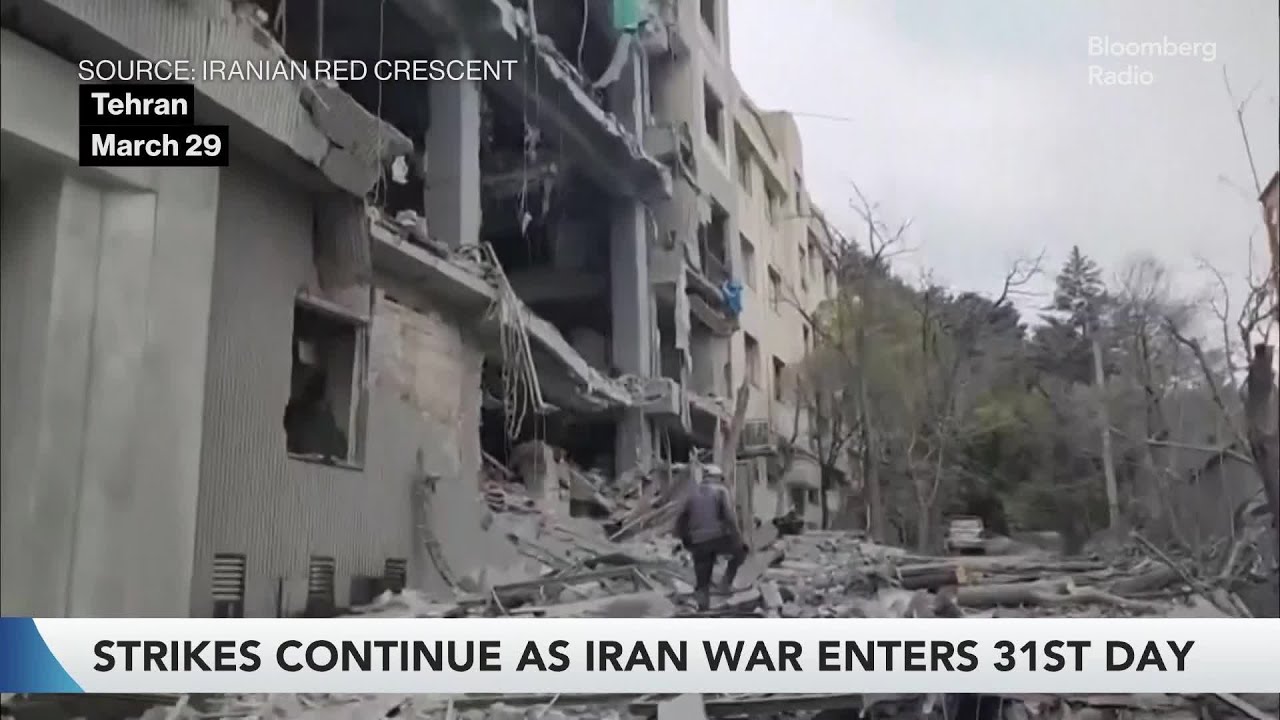
The US leader’s comments came as Israel and Iran exchanged missile strikes with the war continuing into a second month. The conflict is threatening to cause severe economic damage around the world, with the closure of the critical Hormuz waterway choking supplies of energy, fertilizer and other critical commodities.
US Treasury Secretary Scott Bessent told Fox News the US is “going to retake control” of Hormuz, ensuring safe navigation “through US escorts or a multinational escort.” This idea was initially raised in the early weeks of the war, though so far hasn’t been achieved. The White House threatened further escalation of attacks on Iran, including critical civilian energy infrastructure, as the fifth week of war jolts global markets with little sign of relief.
President Donald Trump earlier on Monday posted on social media that if Tehran doesn’t re-open the Strait of Hormuz, “we will conclude our lovely ‘stay’ in Iran by blowing up and completely obliterating” electricity plants, oil facilities and “possibly” desalination infrastructure.
Trump has regularly vacillated between saying a deal with Iran is imminent and warning he’s prepared to increase the military tempo. The threat to water facilities would constitute a war crime as defined by the Geneva Conventions.
White House Press Secretary Karoline Leavitt said the US is “conducting more intense, targeted strikes with devastating combat power with each passing day” and the US operations are proceeding “according to plan,” even as she echoed the president in saying talks are on track. The administration hasn’t identified which Iranian officials it’s dealing with, directly or indirectly.
Despite the mystery surrounding peace talks, Leavitt said the Iranians were “increasingly eager” to negotiate and agreed to “some of the points” that the US has put forward to end the conflict. Iran has consistently said peace talks aren’t progressing and has signaled it can carry on fighting for much longer.
“These folks are appearing more reasonable behind the scenes,” Leavitt added.
The back-and-forth on negotiations happened as Israel and Iran exchanged missile strikes. The conflict is threatening to cause severe economic damage around the world, with the near-closure of the critical Hormuz waterway choking supplies of energy, fertilizer and other critical commodities.
Oil prices rose again on Monday with US crude futures ending the session above $100 a barrel for the first time since 2022. The key psychological threshold was breached as the national average pump price for gasoline also nears $4 a gallon.
--------
Watch Bloomberg Radio LIVE on YouTube
Weekdays 7am-6pm ET
Follow us on X
Subscribe to our Podcasts:
Bloomberg Daybreak
Bloomberg Surveillance
Bloomberg Intelligence
Balance of Power
Bloomberg Businessweek
Listen on Apple CarPlay and Android Auto with the Bloomberg Business app:
Apple CarPlay
Android Auto
Visit our YouTube channels:
Bloomberg Podcasts
Bloomberg Television
Bloomberg Originals
Sentinel Indexing in Progress
Metadata and chapters are available. Claim extraction for this episode is pending.
All video content is delivered via YouTube embedded players in accordance with the YouTube Terms of Service. Sentinel provides research tools that promote discovery and accountability across political media.