Daniel Davis Deep Dive
@danieldavisdeepdive·442K subscribers·4.9K videos
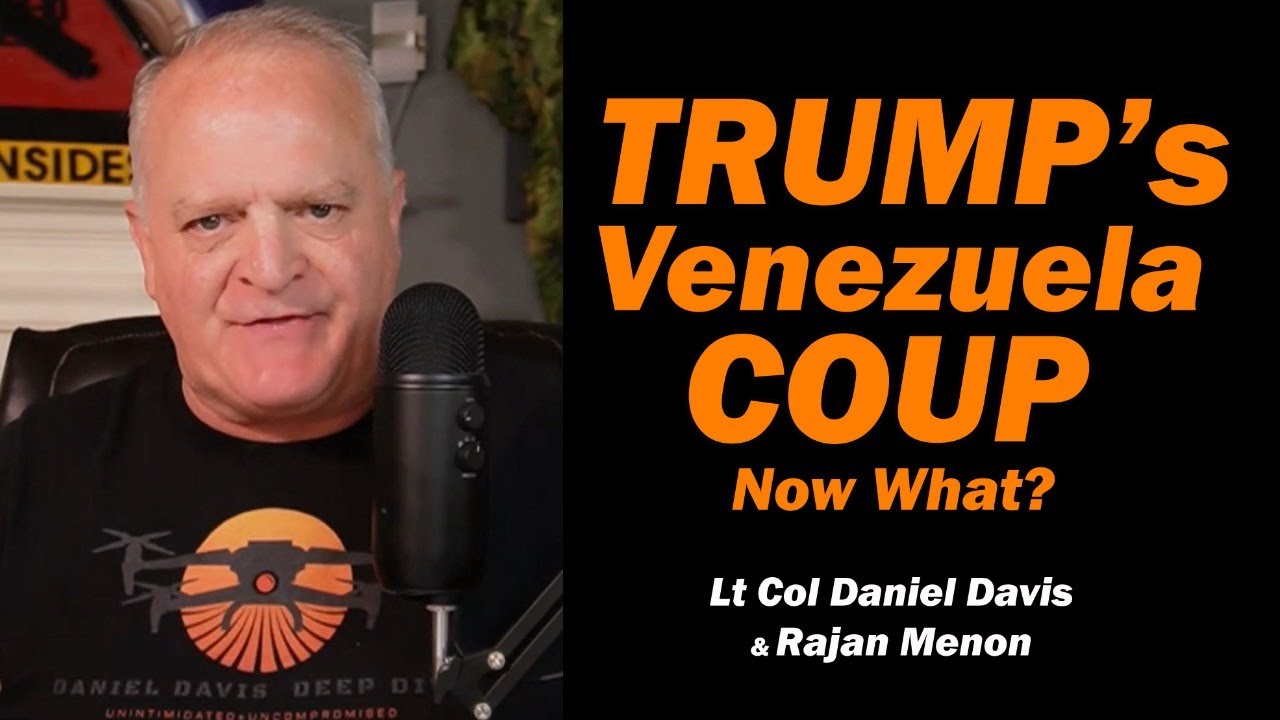
Trump's Venezuela Coup - Now What? /Lt Col Daniel Davis & Rajan Menon
Posted
January 5, 2026
Views
25,522
Likes
1,702
Comments
279
Engagement
January 5, 2026
25,522
1,702
279
7.76%
Every word spoken in this episode is indexed. Type any phrase to jump straight to the moment it was said.
Type any word or phrase that may have been spoken. Click a result to seek the player to that exact moment.
Try a name, a topic, or a quoted line
 40:55Now Playing
** NEW MERCH ** Jackets & Sweatshirts, Thermo Mugs!!
Daniel Davis Deep Dive Merch: Etsy store
After Trump’s illegal Venezuela coup, there are two dangers: he is emboldened, but has no clue what comes next
The segment argues that the U.S. operation removing Venezuela’s president constitutes a coup under international law: the United States militarily intervened in a sovereign state, forcibly removed its sitting leader, and caused dozens of deaths. Regardless of disputes over the president’s legitimacy or governance, he was internationally recognized, making the action a coup by definition.
Key concerns center on what comes next and the lack of planning for consequences. Guest scholar Rajan Menon notes that while the operation may have been tactically efficient, it sets dangerous precedents and exposes the U.S. to legal, political, and strategic fallout.
At the UN Security Council, U.S. Ambassador Mike Waltz forcefully defended the action, framing Venezuela as a hub for U.S. adversaries (Iran, Hezbollah, gangs, Cuban intelligence) and asserting U.S. dominance in the Western Hemisphere. This rhetoric reflects a revived Monroe Doctrine/Trump corollary, emphasizing U.S. primacy in the region.
Menon counters that:
International law allows force mainly in self-defense against an actual or imminent attack—neither applied here.
Claims that Venezuela posed a direct threat to the U.S., U.S. forces, or energy security are unsupported.
Assertions linking Venezuela to major U.S. drug deaths are contradicted by U.S. government reports, which point primarily to Colombia and Mexico routes.
Sovereignty is not contingent on regime quality; poor governance does not justify foreign overthrow.
The discussion also criticizes double standards: the U.S. claims a sphere of influence in the Americas while rejecting similar claims by Russia or China elsewhere. This undermines norms the U.S. says it upholds.
Politically, while many Americans oppose the action, a majority of Republicans reportedly support it, suggesting domestic backing that could embolden further interventions. Commentary from U.S. figures implying pressure—or force—to compel Venezuela’s new leadership raises fears of escalation and continued interference without legal or moral grounding.
Overall, the segment warns that the coup-like action, justified by inflated threats and hemispheric dominance claims, risks long-term damage to international law, U.S. credibility, and regional stability.
Sentinel Indexing in Progress
Metadata and chapters are available. Claim extraction for this episode is pending.
All video content is delivered via YouTube embedded players in accordance with the YouTube Terms of Service. Sentinel provides research tools that promote discovery and accountability across political media.