Dr John Campbell
@campbellteaching·3.3M subscribers·3.1K videos
Vitamin D reduces hospital risk
Posted
July 5, 2021
Views
213,920
Likes
9,083
Comments
1,934
Engagement
5.15%
July 5, 2021
213,920
9,083
1,934
5.15%
Every word spoken in this episode is indexed. Type any phrase to jump straight to the moment it was said.
Type any word or phrase that may have been spoken. Click a result to seek the player to that exact moment.
Try a name, a topic, or a quoted line
 13:59Now Playing
Vitamin D deficiency is associated with higher hospitalisation risk from COVID-19: a retrospective case-control study (June 2021)
Not funded
Large scale, retrospective case-control study
North West of England
Two hospital groups
Lancaster and Tameside and Glossop
Objective
Is hospitalisation with COVID-19 more prevalent with lower vitamin D levels
Individuals with results of serum 25-hydroxyvitamin D (25[OH]D)
1st April 2020 and 29th January 2021
Deficient = less than 25 nmol/L (10 ng/ml)
Insufficient = 25-50 nmol/L (10 to 20 ng/ml)
N = 80,670
1,808 were admitted to hospital with COVID-19
670 died
Primary cohort, n = 58,368
Median vitamin D levels in participants not hospitalised
50 nmol/L (20ng/ml)
(interquartile range, IQR 34.0-66.7 nmol/L)
Median vitamin D levels in participants hospitalised
35.0 nmol/L (14 ng/ml)
(interquartile range, 21.0-57.0nmol/L)
p less than 0.005
Similar findings in a validation cohort, n = 21,234
Non-hospitalised = 47.1 nmol/L (IQR 31.8-64.7 nmol/L)
Hospitalised patients = 33.0 (IQR 19.4-54.1 nmol/L)
p less than 0.005
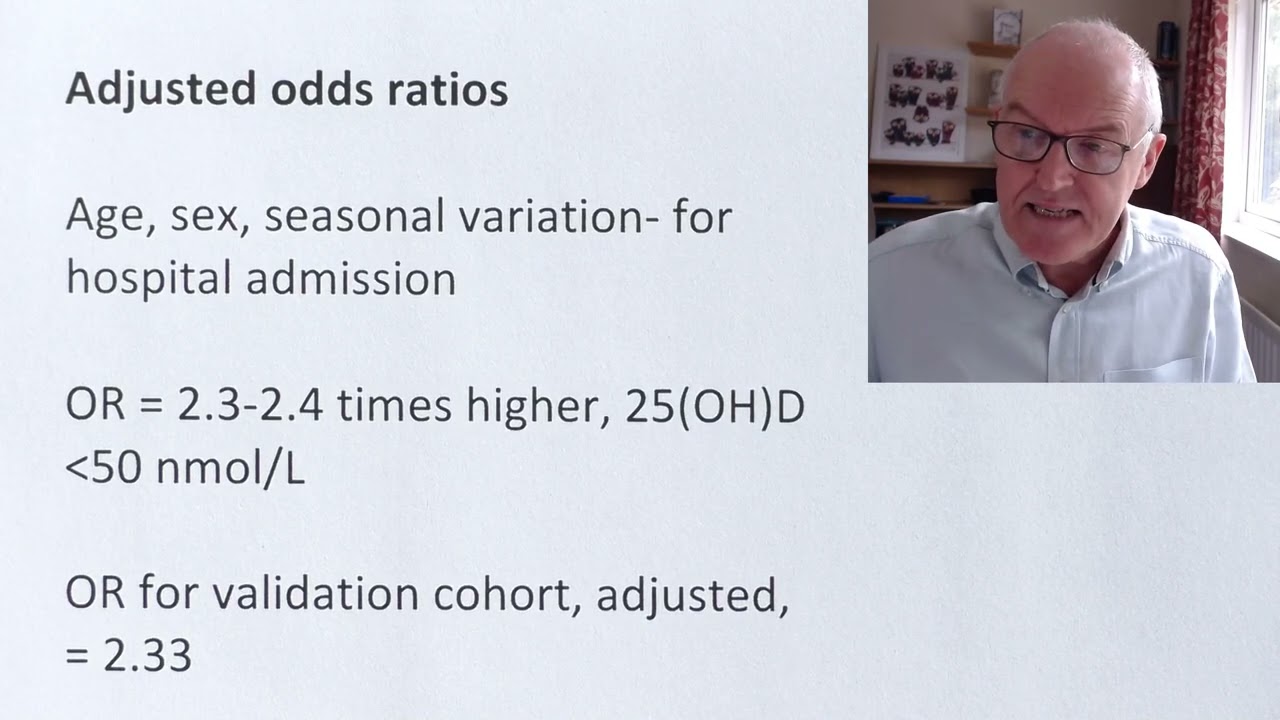
Adjusted odds ratios
Age, sex, seasonal variation- for hospital admission
OR = 2.3-2.4 times higher, 25(OH)D less than 50 nmol/L
OR for validation cohort, adjusted, = 2.33
No association between low vitamin D levels and in-patient hospital mortality from COVID-
19 in either cohort.
Conclusions
Vitamin D deficiency is associated with higher risk of COVID-19 hospitalisation.
Widespread measurement of serum 25(OH)D and treating any unmasked insufficiency or deficiency through testing may reduce this risk
We have clearly demonstrated that vitamin D insufficiency and deficiency exponentially increase the risk of the disease by a factor of 2.3 to 3.6, even after adjustments for age and sex.
Vitamin D is anti-inflammatory, and it has been shown to modulate the immune system
With its effect on macrophage function and innate immunity, vitamin D may alter the disease manifestations of COVID-19
Vitamin D supplementation should be an important consideration for deficient populations at risk
Sentinel Indexing in Progress
Metadata and chapters are available. Claim extraction for this episode is pending.
All video content is delivered via YouTube embedded players in accordance with the YouTube Terms of Service. Sentinel provides research tools that promote discovery and accountability across political media.