Free Forum for Real Economic Emancipation
@freefreeforum·36.8K subscribers·111 videos
Disproportionate Force: The long history of anti-colonial resistance.
Posted
August 12, 2026
Views
2,246
Comments
24
Engagement
1.07%
August 12, 2026
2,246
24
1.07%
Every word spoken in this episode is indexed. Type any phrase to jump straight to the moment it was said.
Type any word or phrase that may have been spoken. Click a result to seek the player to that exact moment.
Try a name, a topic, or a quoted line
Episode Timeline
Every episode in order around the one you’re watching — click any card and the page flips straight to it.
 1:17:28Now Playing
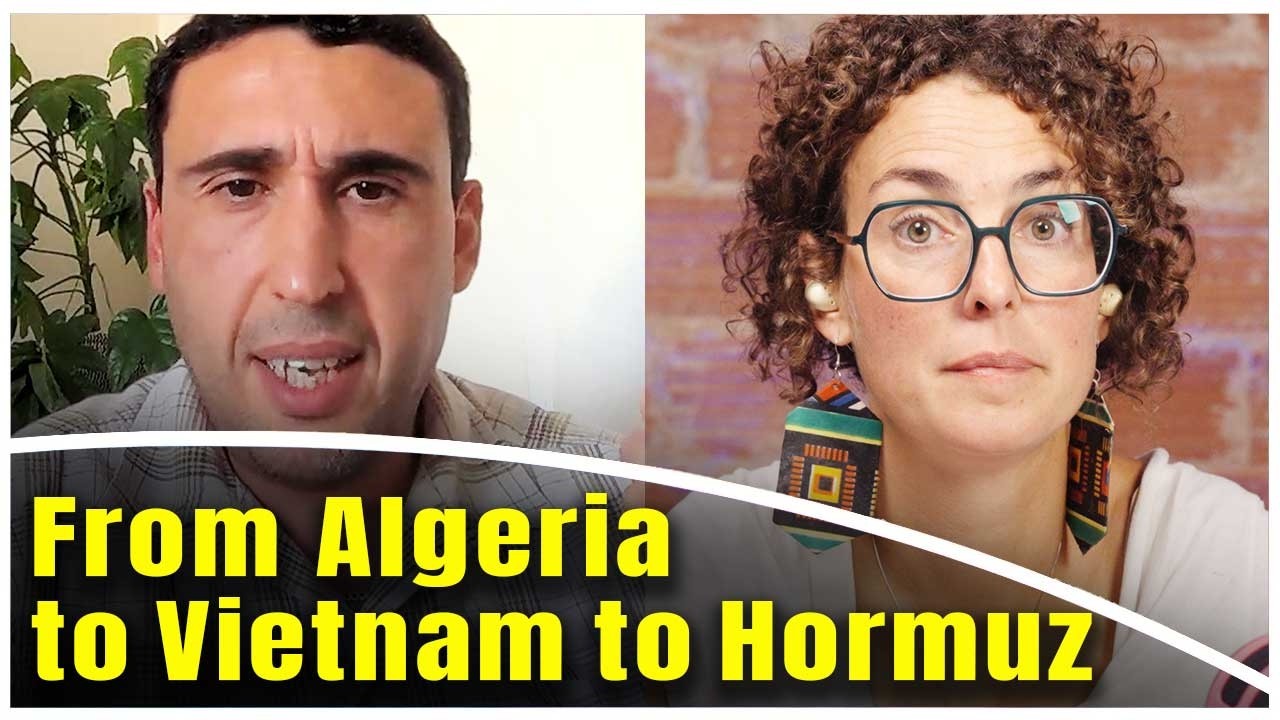
Hamza Hamouchene on French colonialism in Algeria, Frantz Fanon, Dien Bien Phu, and the anti-colonial history linking Vietnam, Algeria, and Palestine today.
He is coeditor of the recently published book Towards Palestinian LiberationGlobal Perspectives on AntiColonial Resistance and Solidarity, a collection praised by a wide ranging group of international scholars including Laleh Khalili, Andreas Malm and Yanis Varoufakis. He joins Clara Mattei to trace that history from Vietnam to Algeria and onward.
France occupied Algeria for 132 years. Three million Algerians died in the first five decades of what the colonial authorities called pacification. In May 1945, while Europe celebrated the defeat of fascism, Algerians marched peacefully in Sétif carrying their flag for the first time. Roughly 45,000 were killed in the two months that followed. By 1962, a quarter of the population had been confined in camps and 8,000 villages destroyed.
Most of this appears nowhere in standard histories of France, and Hamza explains why the omission matters. Demands for self-determination meet disproportionate force, the response becomes the entire story, and the larger violence that produced it drops from view.
Frantz Fanon read the French defeat at Dien Bien Phu in May 1954 as a victory belonging to every colonized nation. Algerians launched their revolution six months later. Hamza follows the solidarities behind it: Algerian and Moroccan dockworkers refusing to load cargo bound for Vietnam, Abd el-Krim writing from exile in Cairo, Palestinians funding and training movements across Latin America and Africa long before anyone spoke of a Global South. Bandung in 1955 and the New International Economic Order of 1974 grew from the same soil.
Clara then turns to Adam Hanieh's chapter and the political economy of Western policy in the region. Hanieh identifies two pillars of US domination: Israel as an imperial outpost, and the oil monarchies of the Gulf. Normalization agreements from Camp David through the Abraham Accords work to bring those pillars together. The prize is control of the Strait of Hormuz, the Red Sea, and the Suez Canal, which means leverage over global energy, fertilizer, plastics, and the trade routes carrying Chinese goods to Africa and Europe. A human rights framework explains none of this, which is much of why it remains the framework on offer.
Clara connects the argument to FREE's recent Tulsa forum on data centers. The dispossession Oklahomans are organizing against runs on the same economic logic Hamza describes.
Hamza Hamouchene is Programme Coordinator for North Africa at the Transnational Institute and the author of several works on political ecology and extractivism in North Africa.
Chapters
🔔 Subscribe to FREE (Forum for Real Economic Emancipation) @FreeFreeForum
❤️ Watch, learn more, and join the FREE Forum
🌱 Support FREE & Help Us Grow
or on Patreon
🎧 Listen as a Podcast
Apple Podcasts
▶ Connect with FREE
#vietnam #algeria #colonialism
Sentinel Indexing in Progress
Metadata and chapters are available. Claim extraction for this episode is pending.
All video content is delivered via YouTube embedded players in accordance with the YouTube Terms of Service. Sentinel provides research tools that promote discovery and accountability across political media.