Military1945
@m1945·37K subscribers·441 videos
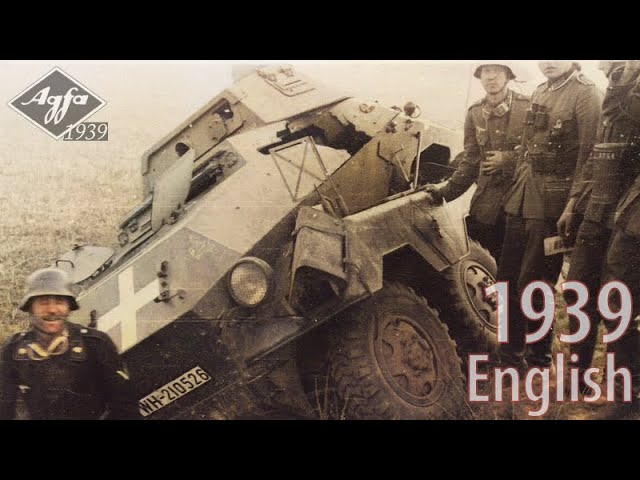
German Newsreel with orig. ENGLISH commentary ATW № 1, 1939 THE POLISH CAMPAIGN
Posted
December 22, 2024
Views
7,461
Likes
445
Comments
76
Engagement
December 22, 2024
7,461
445
76
6.98%
Every word spoken in this episode is indexed. Type any phrase to jump straight to the moment it was said.
Type any word or phrase that may have been spoken. Click a result to seek the player to that exact moment.
Try a name, a topic, or a quoted line
 13:25Now Playing
🔥PREVIEW ALL YOUTUBE VIDEOS
www.Patreon.com/Military1945
Episode 280
Be sure to give this video a THUMBS UP! Best way to support the channel!
SUBSCRIBE to M1945
Ausland-Tonwoche
Nr. 001 late September, 1939
On 1 September 1939 German forces invaded Poland, triggering World War II. The Luftwaffe begun the invasion by bombing the undefended town of Wieluń. The Luftwaffe was an instrumental component of the Blitzkrieg battle plan. The Luftwaffe assigned two airfleets to the campaign. Albert Kesselring's Luftflotte 1 was equipped with 807 aircraft, which was augmented by 92 Seaplanes of Fliegerfuhrer der Seeluftstreitkrafte. Alexander Löhr's Luftflotte 4 had 627 aircraft, augmented by 30 Slovak aircraft. A further 406 fighters were retained as part of home defence against potential Polish attack, while another 333 reconnaissance aircraft, under the command of Kommandeur der Luftwaffe, were attached to the army.
The Junkers Ju 87 Stuka dive bombers carried out the first mission of the campaign, twenty minutes before war was officially announced. The dive bombers scored the first aerial victory of the war when Kettenführer Leutnant Frank Neubert shot down a Polish PZL P.11c fighter aircraft piloted by Captain Mieczysław Medwecki.
The Polish bomber units did attempt to strike at the German Panzer (armored) divisions and slow the speed of advance. Units equipped with PZL.37 Łoś bomber were destroyed within days. The Messerschmitt Bf 110 was proving itself to be more than capable in both the escort and bomber intercept role and accounted for the majority of these victories, which pleased Hermann Göring, a fan of the twin-engined heavy fighter.
The Polish fighter units were still active, and were inflicting small losses on the Luftwaffe, however the Jagd and Zerstörergruppen were increasing their ground attack roles. As a result, many Polish fighters were caught taking off, when they were at a considerable disadvantage. It was indirect rather than direct air support which won the Luftwaffe air-superiority. By destroying communications the Luftwaffe increased the pace of the advance which overran Polish airstrips and early warning sites and caused logistical problems for the Polish forces. Many Polish Air Force units were by then low on supplies, 98 of their number withdrew into neutral (at that time) Romania. Their initial strength of 397 had been reduced to just 54 by 14 September and air opposition virtually ceased.
Part of the Luftwaffe's operations involved the destruction of the small but modern Polish Navy. The Luftwaffe had few units capable of effective anti-shipping operations. One of these units was 4.(St)/TrGr 186 – a Stuka unit which originally had been trained to operate from the German aircraft carrier Graf Zeppelin. 4.(St)/TrGr 186's most notable success was to sink the destroyer Wicher and mine-layer Gryf.
The Luftwaffe had been successful in neutralizing Polish air and sea power within first days of campaign, and with air superiority established the Luftwaffe was free to concentrate on attacking supply and communication links with devastating effect. The outdated Polish Army was denied what mobility it had left as traveling by road became perilous and the rail networks had been largely destroyed.
The Stuka became the symbol of the German war machine throughout the campaign. Operating without opposition, it supported the Panzer divisions by acting as flying artillery. On one occasion six Polish divisions trapped by encircling German forces were forced to surrender after a relentless four-day assault by StG 51, StG 76 and StG 77. Employed in this assault was the 50 kg fragmentation bombs which caused appalling damage to enemy ground troops. Demoralized, the Poles surrendered.
The Polish Air Force was defeated in just over two weeks. The Poles had distributed their operational planes to satellite airfields, so what was left on the airfields was unserviceable aircraft which were then destroyed by the Luftwaffe which is where the incorrect statement that the Polish Air Force was destroyed on the ground originated from.
Sentinel Indexing in Progress
Metadata and chapters are available. Claim extraction for this episode is pending.
All video content is delivered via YouTube embedded players in accordance with the YouTube Terms of Service. Sentinel provides research tools that promote discovery and accountability across political media.