Military1945
@m1945·37K subscribers·441 videos
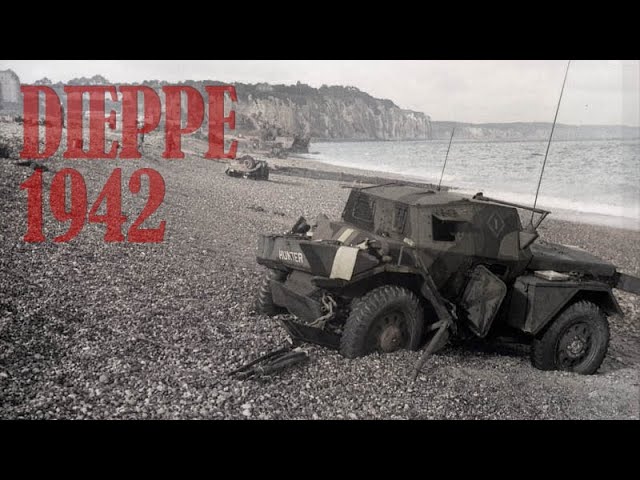
Treason on the Airwaves: An American Newsreel of the 1942 Dieppe Disaster
Posted
October 17, 2025
Views
10,677
Likes
379
Comments
168
Engagement
5.12%
October 17, 2025
10,677
379
168
5.12%
Every word spoken in this episode is indexed. Type any phrase to jump straight to the moment it was said.
Type any word or phrase that may have been spoken. Click a result to seek the player to that exact moment.
Try a name, a topic, or a quoted line
 15:06Now Playing
🔥PREVIEW ALL YOUTUBE VIDEOS
www.Patreon.com/Military1945
Episode 297
Operation Jubilee or the Dieppe Raid (19 August 1942) was a disastrous Allied amphibious attack on the German-occupied port of Dieppe in northern France, during the Second World War. Over 6,050 infantry, predominantly Canadian, supported by a regiment of tanks, were put ashore from a naval force operating under the protection of Royal Air Force (RAF) fighters.
The port was to be captured and held for a short period, to test the feasibility of a landing and to gather intelligence. German coastal defences, port structures and important buildings were to be demolished. The raid was intended to boost Allied morale, to demonstrate the commitment of the United Kingdom to re-open the Western Front, and to support the Soviet Union, which was fighting on the Eastern Front.
The Luftwaffe made a maximum effort against the landing as the RAF had expected, and the RAF lost 106 aircraft (at least 32 to anti-aircraft fire or accidents) against 48 German losses. The Royal Navy lost 33 landing craft and a destroyer. Aerial and naval support was insufficient to enable the ground forces to achieve their objectives. The tanks were trapped on the beach and the infantry was largely prevented from entering the town by obstacles and German fire.
After less than six hours, mounting casualties forced a retreat. Within ten hours, 3,623 of the 6,086 men who landed had been killed, wounded, or taken prisoner. 5,000 were Canadians, who suffered a 68% casualty rate, with 3,367 killed, wounded or taken prisoner. The operation was a fiasco in which only one landing force temporarily achieved its objective, and a small amount of military intelligence was gathered.
Both sides learnt important lessons regarding coastal assaults. The Allies learnt lessons that influenced the success of the D-Day landings. Artificial harbours were declared crucial, tanks were adapted specifically for beaches, a new integrated tactical air force strengthened ground support, and capturing a major port at the outset was no longer seen as a priority. Churchill and Mountbatten both claimed that these lessons had outweighed the cost. The Germans also believed that Dieppe was a learning experience and made a considerable effort to improve the way they defended the occupied coastlines of Europe.
DIEPPE
Dieppe, a coastal town in the Seine-Inférieure department of France, is built along a long cliff that overlooks the English Channel. The river Scie is on the western end of the town and the Arques flows through the town and into a medium-sized harbour. In 1942, the Germans had demolished some seafront buildings to aid in coastal defence and had set up two large artillery batteries at Berneval-le-Grand and Varengeville-sur-Mer. One important consideration for the planners was that Dieppe was within range of the RAF's fighter aircraft.
There was also intense pressure from the Soviet government to open a second front in Western Europe. By early 1942, the Wehrmacht's Operation Barbarossa had clearly failed to destroy the Soviet Union. However, the Germans in a much less ambitious summer offensive launched in June, were deep into southern Soviet territory, pushing toward Stalingrad. Joseph Stalin himself repeatedly demanded that the Allies create a second front in France to force the Germans to move at least 40 divisions away from the Eastern Front to remove some of the pressure put on the Red Army in the Soviet Union.
The proposed Allied invasion of continental Europe in 1943, Operation Roundup, was considered impractical by military planners, and the alternative of landing in 1942, Operation Sledgehammer, even more difficult. The British had been engaged with the Italians and the Germans in the Western Desert campaign since June 1940. At the Second Washington Conference in June 1942, U.S. President Franklin D. Roosevelt and British Prime Minister Winston Churchill decided to postpone the cross-English Channel invasion and schedule Operation Torch, the Anglo-American invasion of French North Africa, for later that year. In the interim, a large-scale Canadian-led raid on the French coast was intended to take some of the pressure off the Soviet Union.
Sentinel Indexing in Progress
Metadata and chapters are available. Claim extraction for this episode is pending.
All video content is delivered via YouTube embedded players in accordance with the YouTube Terms of Service. Sentinel provides research tools that promote discovery and accountability across political media.