Nyc Mayors Office
@nycmayorsoffice·150K subscribers·213 videos
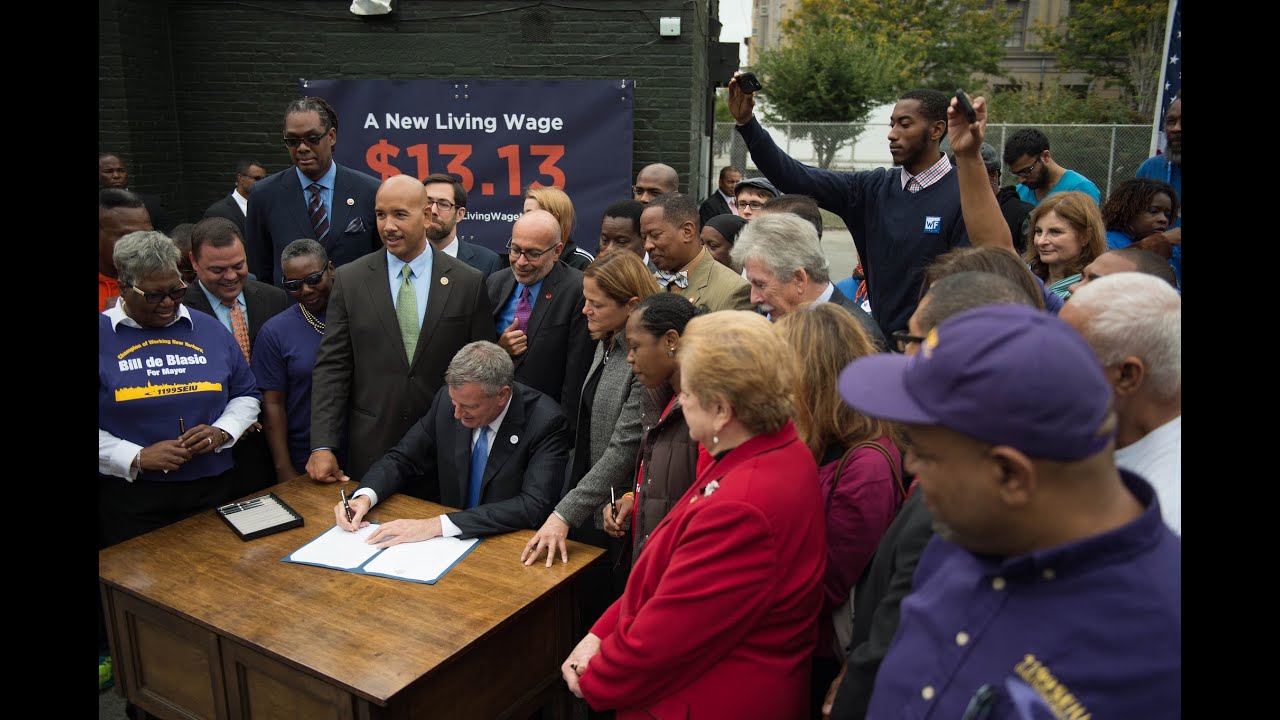
Mayor de Blasio Increases Living Wage and Expands It to Thousands More Workers
Posted
September 30, 2014
Views
2,770
Likes
23
Comments
3
Engagement
September 30, 2014
2,770
23
3
0.94%
Every word spoken in this episode is indexed. Type any phrase to jump straight to the moment it was said.
Type any word or phrase that may have been spoken. Click a result to seek the player to that exact moment.
Try a name, a topic, or a quoted line
 1:02:33Now Playing
Executive Order raises City’s living wage immediately to $13.13 per hour, expected to exceed $15 by 2019
Lowest-wage workers will see pay increase from $16,640 to $27,310 per year
Workers at retailers and fast-food chains at City-backed projects will now earn a living wage
Mayor Bill de Blasio today signed an executive order enacting a sweeping expansion of New York City’s Fair Wages for New Yorkers Act. Effective immediately, commercial tenants at projects that receive more than $1 million in City subsidy will be covered by Living Wage provisions, and the Living Wage itself will be raised to from $11.90 to $13.13 per hour—likely reaching $15.22 per hour by 2019.
Increasing and expanding the Living Wage law is part of a comprehensive approach the de Blasio administration has undertaken to tackle income inequality, including expanding paid sick leave to a half-million more workers, creating new workforce development programs that help workers attain skills to compete for good-paying jobs, and securing local control of the minimum wage from Albany. The new living wage matches the contours of a higher local minimum wage that a broad coalition is working to secure the authority from Albany to implement next year.
While it is difficult to make projections related to economic development, based on past patterns the City estimates the executive order will expand the reach of living wage provisions to 70 percent of all jobs at firms supported by City agencies. The analysis indicates living wage requirements would impact roughly 18,000 jobs over the next five years, compared to 1,200 under the current law. Approximately 4,100 jobs covered under the new standards would be held by employees in retail and fast-food businesses that traditionally pay close to minimum wage.
For workers earning the state’s minimum wage of $8 per hour, a Living Wage would increase their gross income from $16,640 to $27,310 per year.
The Living Wage executive order eliminates an exemption for future development at Hudson Yards, bringing thousands of additional jobs under living wage provisions in the years ahead. The order will not pertain to specific types of City-backed housing developments with high levels of affordability, small businesses with gross income under $3 million, and manufacturers, for which agencies will instead pursue skill-building and upward mobility on the career ladder in exchange for City support.
The Living Wage will be set at $13.13 without benefits, or $11.50 per hour with benefits, and will be adjusted each year to match changes in the Consumer Price Index. It previously stood at $10.30 with benefits and $11.90 without.
The Living Wage will be enforced by the Department of Consumer Affairs.
St. Mary’s Playground West, in St. Mary’s Park
Bronx, NY
Sentinel Indexing in Progress
Metadata and chapters are available. Claim extraction for this episode is pending.
All video content is delivered via YouTube embedded players in accordance with the YouTube Terms of Service. Sentinel provides research tools that promote discovery and accountability across political media.