Aydin Paladin
@aydinpaladin·140K subscribers·292 videos
Emotional Contagion & Late Night Lies
Posted
October 14, 2017
Views
79,460
Likes
3,733
Comments
747
Engagement
5.64%
October 14, 2017
79,460
3,733
747
5.64%
Every word spoken in this episode is indexed. Type any phrase to jump straight to the moment it was said.
Type any word or phrase that may have been spoken. Click a result to seek the player to that exact moment.
Try a name, a topic, or a quoted line
 44:25Now Playing
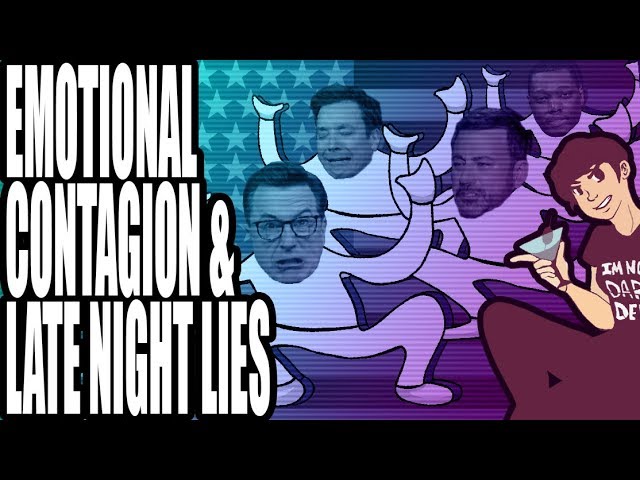
Have you noticed late night television that's supposed to amuse and entertain recently hasn't been so, well, entertaining? Why is the former host of the Man Show now running an emotion-fueld Estrogen Hour? How come politics have seemingly taken the place of jokes in my previously favorite programs? Well, I think I have an answer: because given the current political climate, these shows are no longer designed to make you laugh, they're designed to make you feel, and they make you feel through a process of emotional contagion designed to affect your attitudes toward a topic with a given agenda.
Also, sorry about my voice, I've got a dang cold.
You can gib shekels on Patreon:
patreon.com/AydinPaladin
References:
Attardo, S. (1997). The semantic foundations of cognitive theories of humor. Humor-International Journal of Humor Research, 10(4), 395-420.
Barsade, S. G. (2002). The ripple effect: Emotional contagion and its influence on group behavior. Administrative Science Quarterly, 47(4), 644-675.
Brehm, J. W., & Cohen, A. R. (1962). Explorations in cognitive dissonance. The Public Opinion Quarterly, 29(5), 511-514.
Brehmer, B. (1976). Social judgment theory and the analysis of interpersonal conflict. Psychological bulletin, 83(6), 985.
Brewer, M. B. (1999). The psychology of prejudice: Ingroup love and outgroup hate?. Journal of social issues, 55(3), 429-444.
Burton, C. M., Plaks, J. E., & Peterson, J. B. (2015). Why do conservatives report being happier than liberals? The contribution of neuroticism. Journal of Social and Political Psychology, 3(1), 89-102.
Carney, D. R., Jost, J. T., Gosling, S. D., & Potter, J. (2008). The secret lives of liberals and conservatives: Personality profiles, interaction styles, and the things they leave behind. Political Psychology, 29(6), 807-840.
Cialdini, R. (1984). Influence: Science and Practice. Boston, MA: Pearson Education.
Goodboy, A. K., Booth-Butterfield, M., Bolkan, S., & Griffin, D. J. (2015). The role of instructor humor and Students’ Educational Orientations in student learning, extra effort, participation, and out-of-class Communication. Communication Quarterly, 63(1), 44-61.
Graham, J., Haidt, J., & Nosek, B. A. (2009). Liberals and conservatives rely on different sets of moral foundations. Journal of personality and social psychology, 96(5), 1029.
Hatfield, E., Cacioppo, J. T., & Rapson, R. L. (1992). Primitive emotional contagion. Review of personality and social psychology, 14, 151-177.
Hatfield, E., Cacioppo, J. T., & Rapson, R. L. (1993). Emotional contagion. Current directions in psychological science, 2(3), 96-100.
Hatfield, E., Cacioppo, J. T., & Rapson, R. L. (1994). Emotional contagion: Cambridge studies in emotion and social interaction. Cambridge, UK: Cambridge University Press. errors-in-variables regression model when the variances of the measurement errors vary between the observations. Statistics in Medicine, 21, 1089-1101.
Horton, D., & Richard Wohl, R. (1956). Mass communication and para-social interaction: Observations on intimacy at a distance. Psychiatry, 19(3), 215-229.
Howard, D. J., & Gengler, C. (2001). Emotional contagion effects on product attitudes. Journal of Consumer research, 28(2), 189-201.
McCrae, R. R. (1996). Social consequences of experiential openness. Psychological bulletin, 120(3), 323.
McCroskey, J. C., & McCain, T. A. (1974). The measurement of interpersonal attraction. Speech Monographs, 41, 261-266.
McGraw, A. P., Williams, L. E., & Warren, C. (2014). The rise and fall of humor: Psychological distance modulates humorous responses to tragedy. Social Psychological and Personality Science, 5(5), 566-572.
Rozin, P., & Royzman, E. B. (2001). Negativity bias, negativity dominance, and contagion. Personality and social psychology review, 5(4), 296-320.
Rubin, R. B., & McHugh, M. P. (1987). Development of parasocial interaction relationships. Journal of Broadcasting & Electronic Media, 31(3), 279-292.
Sherif, M., & Hovland, C. I. (1961). Social judgment: Assimilation and contrast effects in communication and attitude change. American Journal of Sociology, 68(1) 126-127.
Zaccaro, S. J., & McCoy, M. C. (1988). The effects of task and interpersonal cohesiveness on performance of a disjunctive group task. Journal of applied social psychology, 18(10), 837-851.
Sentinel Indexing in Progress
Metadata and chapters are available. Claim extraction for this episode is pending.
All video content is delivered via YouTube embedded players in accordance with the YouTube Terms of Service. Sentinel provides research tools that promote discovery and accountability across political media.