Big Think
@bigthink·8.8M subscribers·10.1K videos
Daniel Koretz on the Last 30 Years of American Education | Big Think
Posted
April 24, 2012
Views
718
Likes
9
Comments
1
Engagement
1.39%
April 24, 2012
718
9
1
1.39%
Every word spoken in this episode is indexed. Type any phrase to jump straight to the moment it was said.
Type any word or phrase that may have been spoken. Click a result to seek the player to that exact moment.
Try a name, a topic, or a quoted line
 6:54Now Playing
Daniel Koretz on the Last 30 Years of American Education
New videos DAILY
Join Big Think Edge for exclusive videos
----------------------------------------------------------------------------------
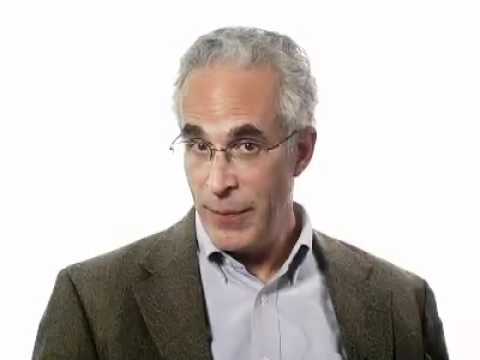
Daniel Koretz has seen a steady trend toward arbitrarily high graduation standards even for kids with cognitive disabilities.
----------------------------------------------------------------------------------
Daniel Koretz:
Daniel Koretz is the Henry Lee Shattuck Professor of Education at Harvard Graduate School of Education. He focuses his research primarily on educational assessment, particularly as a tool of education policy. A primary emphasis in his work has been the effects of high-stakes testing, including effects on schooling and the validity of score gains. His research has included studies of the effects of testing programs, the assessment of students with disabilities, international differences in the variability of student achievement, the application of value-added models to educational achievement, and the development of methods for validating scores under high-stakes conditions. His current work focuses on the design and evaluation of test-focused educational accountability systems. Dr. Koretz founded and chairs the International Project for the Study of Educational Accountability, an international network of scholars investigating improved approaches to educational accountability. Dr. Koretz is a member of the National Academy of Education. His doctorate is in developmental psychology from Cornell University. Before obtaining his degree, Dr. Koretz taught emotionally disturbed students in public elementary and junior high schools.
----------------------------------------------------------------------------------
TRANSCRIPT:
Daniel Koretz:
We started down this road in the early 1970s when a number of states started imposing what were then called minimum competency tests. These were very easy tests basically aimed at 10 or 15% of the school age population, not the rest, to ensure that kids at the bottom of the distribution had basic skills that policy makers thought they needed to go out and do some work. The assumption was that most kids are passed, most kids did. One statistician who worked on this issue at the time said that if the failure rate got above 12%, it was time to go back to the legislature. This lasted about 10 years, little less, it really swept the country. By the end of 1970s, a lot of states were doing this. In the 1980s, there was a somewhat diffused change state by state in several ways. First of all, there was a growing interest in holding educators in schools accountable rather than kids or in addition to kids, which was a fundamental change. There was a growing discomfort with holding people accountable only for very easy tests. There was a notion that we ought to be setting the bar higher. And so, states began to experiment with ways of holding schools accountable. It took about 10 years, but by the early 1990s, we were beginning to see the kinds of things that now [sharpened] No Child Left Behind. So for instance, by 1992, Kentucky, which I’ll use as one example, put in place a policy that rewarded and punished schools for changes in test scores, which is the lynchpin of No Child Left Behind. They didn’t do it quite the same way the No Child Left Behind does. But all schools were given targets. The targets were just as today’s are completely arbitrary. The time to reach those targets was also arbitrary, it was… in that case, 20 years rather than the current 12. And then, every school received either rewards or punishments depending on how much better than expected or worse than expected [perform] in test scores. By the time No Child Left Behind was passed, the majority of states had something like that in place. About half the states had so-called high school exit exams, a test that kids had to pass in order to get diplomas, though that constantly shifted. A state would get close to the jumping off the diving board and say, “Whoa, whoa, whoa, we’re going to fail too many kids,” and they back off. And another state would go forward. But, typically, it was about half the states that had either a policy in place or one planned. So, all of that was basically ready to go when George Bush came to office. What he did was cobble together policies that states had been building for about 10 years and add a few wrinkles. And some of those wrinkles seem really arcane but they turned out to be very, very important.
Read the full transcript at
Sentinel Indexing in Progress
Metadata and chapters are available. Claim extraction for this episode is pending.
All video content is delivered via YouTube embedded players in accordance with the YouTube Terms of Service. Sentinel provides research tools that promote discovery and accountability across political media.