Big Think
@bigthink·8.8M subscribers·10.1K videos
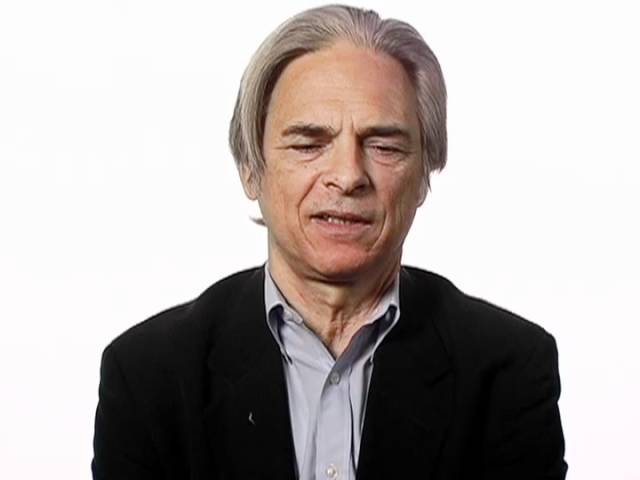
Michael Landau Demonstrates Mobile Banking in Uganda | Big Think
Posted
April 24, 2012
Views
214
Likes
2
Engagement
0.93%
April 24, 2012
214
2
0.93%
Every word spoken in this episode is indexed. Type any phrase to jump straight to the moment it was said.
Type any word or phrase that may have been spoken. Click a result to seek the player to that exact moment.
Try a name, a topic, or a quoted line
See what was published immediately before and after this episode.
 11:16Now Playing
Michael Landau Demonstrates Mobile Banking in Uganda
New videos DAILY
Join Big Think Edge for exclusive videos
----------------------------------------------------------------------------------
The chairman demonstrates how digital technology can improve the lives of Africans.
----------------------------------------------------------------------------------
Mr. Landau:
Mr. Landau is the Chairman of MAP International. He is an entrepreneur who has built a portfolio of ventures in real estate, mortgage banking, information and communication technologies, and advanced banking solutions. He also serves as Chairman of MAP International’s sister company, MAPcash.
Mr. Landau is a former board member of Regalian PLC, a British real estate development company.
Mr. Landau has been an invited speaker at several conferences and forums, among them a presentation on “Africa’s Industrial Drive: The Private Sector and Corporate Citizenship” at the African Union/U.N. Global Compact Private Sector Forum in Addis Ababa. At this event MAP International was featured as “best practice.” Mr. Landau was also an invited speaker at the CHOGM, the Commonwealth Business Forum in November 2007 in Uganda, and was recently an invited speaker at the AOSIS/United Nations Foundation and Friends on Climate Change Roundtable, hosted by the Permanent Mission of India to the United Nations.
Active in community-based initiatives, Mr. Landau has hosted and chaired several political forums and meetings with the New York City Police Department. He is the chairman of the Council of Orthodox Jewish Organizations of Manhattan (New York City), an umbrella group representing the Jewish community to government and political leaders. He also has extensive experience interfacing with UN leaders as a community representative—a relationship that began when he initiated the creation of a UN special stamp edition in remembrance of the International Day of Commemoration for Victims of the Holocaust.
Mr. Landau was recently invited to serve on the board of the World Sports Alliance, an intergovernmental organization whose mission is to use sport as a catalyst to design and implement programs to realize the UN’s Millennium Development Goals. He received his bachelor's degree from the London School of Economics and a master's degree in real estate development and finance from New York University. He received his law degree from Yeshiva University's Cardoza School of Law and is admitted to practice law in New York, New Jersey, and the District of Columbia. He and his wife reside in New York City with their four children.
----------------------------------------------------------------------------------
TRANSCRIPT:
Question: Can you demonstrate how modern banking technology might help Africans?
Michael Landau: Imagine you’re in a village on a Friday night and you get to your village. It’s now 9:00 and your friend’s grandmother is very sick and you need to call the doctor. Problem is is that you go to your phone, you got no money left on your phone. And you look for the guy with a green jacket, yellow jacket to buy the scratch off cards. You can’t find him anywhere ‘cause he’s already, he’s already gone. He comes twice a week. He’s not going to be there ‘til Monday again. So, currently, you know, you hope your grandmother stays well until Monday morning. But now, you say, we’re part of the MAP system. We’re a post bank customer. We’ve actually got a whole mobile banking application. So what we’ll do is, the first thing we’ll do is to check the balance on the account. Now, this system is a live system that operates throughout Uganda but it’s a demonstration so the money is not real money that’s being, it’s not real cash but it’s a real system that’s actually working through Uganda. So if the cellular service is no good in this room over here, this demonstration won’t work. But the first thing we do is we got to balance on the account. So every transaction that we do, you have to check your, we have to get the, we have to put your pin code in. So we put in our pin code and we’re going to check now, see if we have service, you know, over here. If we do, we’re going to have a, our balance is going to be able to come through. And everybody’s going to see how much money I have in my bank account. You can see, 70,198,000 and change in my bank account. It’s roughly 2,000 shillings. It’s roughly $35,000. So now, we have money in the bank account. So now, we’re going to top-up the phones. We go to the buy prepaid and we’re going to put in our pin code.
Read the full transcript at
Sentinel Indexing in Progress
Metadata and chapters are available. Claim extraction for this episode is pending.
All video content is delivered via YouTube embedded players in accordance with the YouTube Terms of Service. Sentinel provides research tools that promote discovery and accountability across political media.