Big Think
@bigthink·8.8M subscribers·10.1K videos
Never Trust Your Judgment During Sex | Big Think
Posted
April 24, 2012
Views
966
Likes
7
Engagement
0.72%
April 24, 2012
966
7
0.72%
Every word spoken in this episode is indexed. Type any phrase to jump straight to the moment it was said.
Type any word or phrase that may have been spoken. Click a result to seek the player to that exact moment.
Try a name, a topic, or a quoted line
Episode Timeline
Every episode in order around the one you’re watching — click any card and the page flips straight to it.
 1:41Now Playing
Never Trust Your Judgment During Sex
New videos DAILY
Join Big Think Edge for exclusive videos
----------------------------------------------------------------------------------
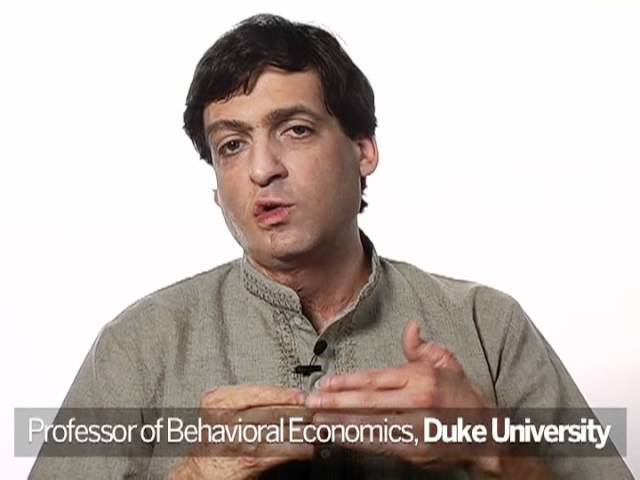
Making decisions while sexually aroused isn’t worth the risk, says Duke economist Dan Ariely.
----------------------------------------------------------------------------------
Dan Ariely:
Dan Ariely is the James B Duke Professor of Psychology and Behavioral Economics at Duke University. He is the founder of The Center for Advanced Hindsight and co-founder of BEworks, which helps business leaders apply scientific thinking to their marketing and operational challenges. His books include Predictably Irrational and The Upside of Irrationality, both of which became New York Times best-sellers. as well as The Honest Truth about Dishonesty and his latest, Irrationally Yours.
Ariely publishes widely in the leading scholarly journals in economics, psychology, and business. His work has been featured in a variety of media including The New York Times, Wall Street Journal, Washington Post, Boston Globe, Business 2.0, Scientific American, Science and CNN.
----------------------------------------------------------------------------------
TRANSCRIPT:
Question - Why is it dangerous to make decisions in the heat of the moment?
Dan Ariely: I don’t know if sexual arousal is the worst time because there’s a lot of things we’re not going to focus on at that moment. But clearly at the heat of the moment is an awful time. And you know the trust game; we have another version of it called the trust game with revenge. So imagine that you’re player A, you send the money to player B and player B took the money and went home. And I would say ‘Look, player A I’m sorry you lost all your money but here, I’ll tell you what; I know how to find player B. If you’ll give me money, for every dollar you give me I’ll find player B and take two dollars away from him. You give me one dollar, I’ll take two from him, you give me three I’ll take six, ten and twenty and so on.’ You can lose more money to get the other guy suffer more. Would you do it, right?
Anybody who ever had a breakup or divorce or so would tell you that the feeling of revenge is incredibly powerful, right. That at the moment that we feel this we’re willing to lose a lot for ourselves to make the other party suffer even more. And it’s an incredibly devastating instinct. But this is what we have. So every time that emotions rule they can get the best out of us and get us to make lots of bad decisions; selling everything in the stock market, shooting emails, annoyed emails to your boss, fighting with spouses, lots of terrible things.
Sentinel Indexing in Progress
Metadata and chapters are available. Claim extraction for this episode is pending.
All video content is delivered via YouTube embedded players in accordance with the YouTube Terms of Service. Sentinel provides research tools that promote discovery and accountability across political media.