Big Think
@bigthink·8.8M subscribers·10.1K videos
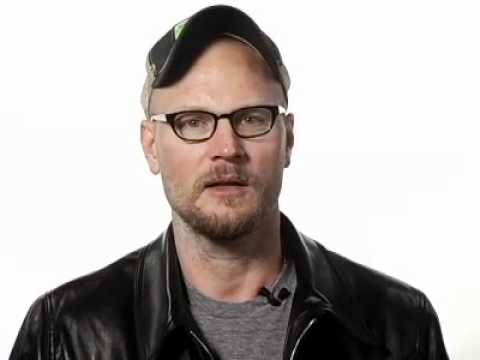
The Art of Memoir | Augusten Burroughs | Big Think
Posted
April 24, 2012
Views
1,131
Likes
17
Comments
3
Engagement
1.77%
April 24, 2012
1,131
17
3
1.77%
Every word spoken in this episode is indexed. Type any phrase to jump straight to the moment it was said.
Type any word or phrase that may have been spoken. Click a result to seek the player to that exact moment.
Try a name, a topic, or a quoted line
Episode Timeline
Every episode in order around the one you’re watching — click any card and the page flips straight to it.
 9:50Now Playing
The Art of Memoir
New videos DAILY
Join Big Think Edge for exclusive videos
----------------------------------------------------------------------------------
Augusten Burroughs agrees with Einstein: “There is no preferred point of view in the universe”
----------------------------------------------------------------------------------
Augusten Burroughs:
Augusten Burroughs was born Christopher Richter Robison in Pittsburgh, PA on October 23, 1965 and raised in Western Massachusetts. Augusten's parents struggled with alcoholism and mental illness and they separated when he was twelve. Augusten stopped attending school and his parents' longtime psychiatrist became his legal guardian. At seventeen, he moved to the Boston area and graduated from Control Data Institute with a diploma in Computer Programming and System's Analysis and Design but never worked in the technology industry. Instead he moved to San Francisco and at 19 became the youngest copywriter in the city. His work attracted national acclaim and in 1989 he was invited by Ogilvy & Mather, New York, to work on their flagship American Express account. Augusten found great success in the Manhattan advertising community, eventually working for many of the top agencies where he created global ad campaigns for worldwide brands. Almost eighteen years after accepting his first advertising job, Augusten left the industry to pursue a career as an author. Two years later, his 2002 memoir, Running with Scissors, became a publishing phenomenon, spending over three consecutive years on the NYT bestseller list. It was made into a movie starring Annette Bening and Alec Baldwin. All of Augusten's subsequent books — Dry, Magical Thinking, Possible Side Effects, A Wolf at the Table, You Better Not Cry & This is How — were instant NYT bestsellers. In 2013, Augusten married his literary agent and best friend, Christopher Schelling, received a Lambda Literary Award, and was honored with a Doctorate of Letters from the Savannah College of Art and Design. Augusten is also a self-taught gemologist with a special interest in jade. He collects and sells vintage and estate jewelry, photographs people, and recently directed his first music video. Augusten and his husband Christopher live in a 200 year old house in rural Connecticut with their three dogs.
----------------------------------------------------------------------------------
TRANSCRIPT:
Question: How do you maintain objectivity?
Augusten Burroughs: I think what you do is you- or at least what I do is I’m able to go back. When I’m writing I’m on- always on a laptop. I am kind of looking-- Well, I’m not really looking anywhere. My eyes are not focused but I’m sort of staring at the little bar between the keys and the screen so that little aluminum strip. I am back there and I am writing kind of as fast as I can to keep up with the action. It’s almost like watching a movie so I don’t ever pause and think oh, should I maybe add a blizzard to this day? Would that make it better?
Here’s an example of memoir, what I feel, because we- there’s a lot of discussion in the media about memoir and fake memoir and all of that. Let’s say that you are in a car and you’re driving down the highway and you are on your way to a party so you’re going fast and all of a sudden on the side of the road you see a terrible car accident. The whole front end of the car is mashed up. It’s devastating. It’s so bad you look away and you look to the person next to you in the passenger seat and you say, “My God, did you see that, those people?”
And you’re shaken by it. And you arrive at the party and they open the door. “Welcome. What’s the matter?” they say.
“Is something wrong?”
And you say, “Well, I just- we were driving here on our way and we saw this horrible, horrible car accident and all I can think about are the children. The parents-- What if they had children and now the parents are dead?”
And just all these awful thoughts you would have. It would kind of shake you for the rest of the night to see a profound car accident like that. Now let’s say that you are the person inside that car. Okay? And let’s say that car happens to be a Mercedes S class or a Volvo, one of the safest cars, so the air bags have deflated and you look down at your arms and your legs and you look at the person next to you and they’re looking and you’re- there’s not a scratch and you look down and you see the heel of your high-heeled shoe is not even broken.
Read the full transcript at
Sentinel Indexing in Progress
Metadata and chapters are available. Claim extraction for this episode is pending.
All video content is delivered via YouTube embedded players in accordance with the YouTube Terms of Service. Sentinel provides research tools that promote discovery and accountability across political media.