Bloomberg Podcasts
@bloombergpodcasts·503K subscribers·32.4K videos
France’s Premier Resigns as Macron Considers Replacement
Posted
September 9, 2025
Views
7,400
Likes
33
Comments
9
Engagement
September 9, 2025
7,400
33
9
0.57%
Every word spoken in this episode is indexed. Type any phrase to jump straight to the moment it was said.
Type any word or phrase that may have been spoken. Click a result to seek the player to that exact moment.
Try a name, a topic, or a quoted line
See what was published immediately before and after this episode.
 4:25Now Playing
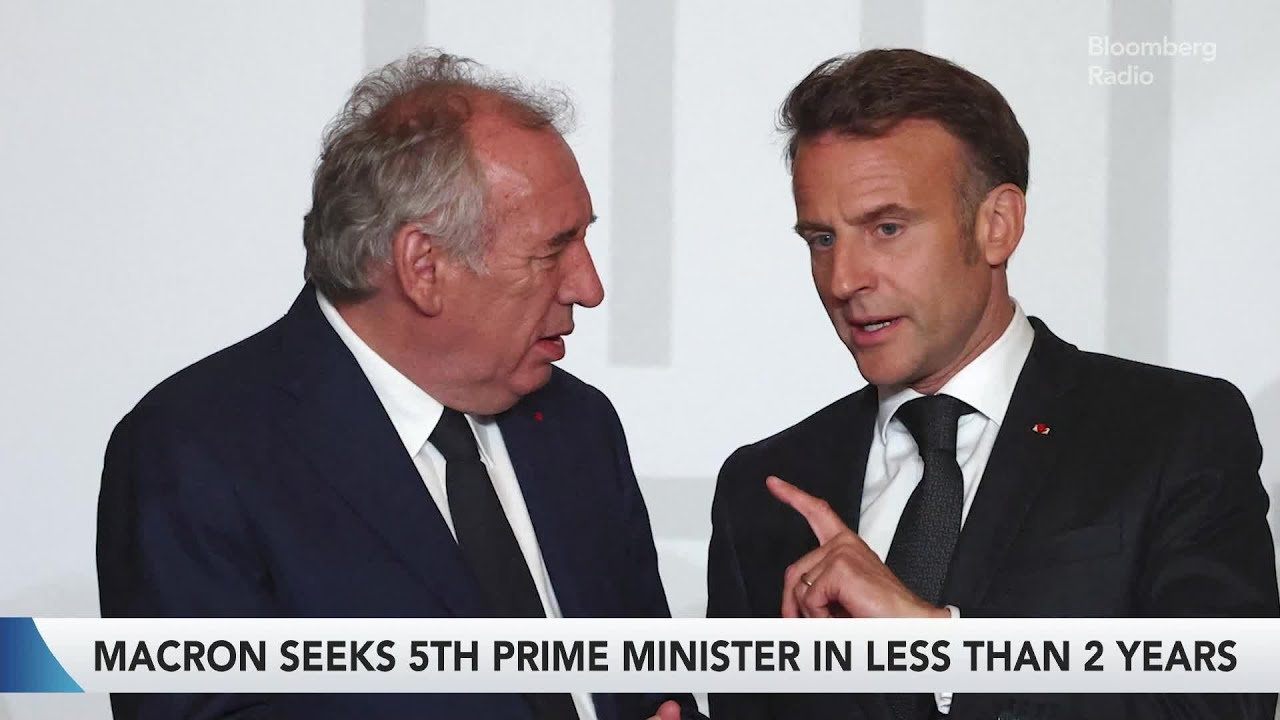
Stephen Carroll, host of Bloomberg Radio's Daybreak Europe, breaks down the latest from Paris and what's next for Emanuel Macron's government.
Francois Bayrou resigned as France’s prime minister Tuesday, putting the onus on President Emmanuel Macron to quickly name a new premier who can stabilize the country’s urgent fiscal situation.
Macron said he would tap a new prime minister in the coming days. Bayrou submitted his resignation and will remain as a caretaker until a successor is named, according to Macron’s office.
Whoever takes on the role will need to assemble a government and then find a way to pass a budget in a fragmented National Assembly, an exercise that’s toppled the last two prime ministers. Meanwhile public pressure is growing with nationwide protests planned.
While Macron doesn’t lack for people who might accept the role, selecting someone who can find common ground among the groups is far from obvious.
“Which party can one even recruit from?” Kathryn Kleppinger, George Washington University professor of French studies said in an interview on Bloomberg Television. “I fear we’re going to be dealing with more of the same.”
Read More: Here Are the Leading Contenders to Be France’s New Premier
French bonds rose on Tuesday, with the 10-year benchmark yielding 3.47%. The CAC 40 Index was up about 0.2% at 3:45 p.m. in Paris.
The new premier will be France’s fifth in less than two years, a reflection of the irreconcilable blocs in the country’s fractured political landscape.
Several of the names floated in French media for the post are in Bayrou’s government, which limits their ability to appeal to parties beyond the centrist groups that had supported the outgoing premier. They include Defense Minister Sebastien Lecornu, who was a front-runner in the last reshuffle for the position, or Labor Minister Catherine Vautrin. Finance Minister Eric Lombard, who was instrumental in building bridges with Socialists to secure the 2025 budget, is another possibility.
Outside of Macron’s core group, Socialist leader Olivier Faure has said that he’s ready to be prime minister. Former Socialists could include Bernard Cazeneuve, a former prime minister under President Francois Hollande or the current head of the state audit court, 67-year-old Pierre Moscovici. If no political profile can work, Macron could try to find a prime minister seen as purely technocratic, but would be an implicit admission from Macron that politics has failed.
The Socialists were quick to propose their services following the vote. “I think it’s time for the left to again govern this country and break with the policies that have been implemented for the past eight years,” Faure said on TF1 television, referring to Macron’s time in office.
At the same time, on France 2 television, outgoing interior minister Bruno Retailleau, who also heads the center-right Republicans, said he wouldn’t take part in a government led by a Socialist prime minister. Speaking on the same channel, far-left firebrand Jean-Luc Melenchon also said he would not support a government led by Faure.
Bayrou called Monday’s confidence vote in an effort to get backing for his proposed €44 billion of spending cuts and tax hikes that would narrow France’s 2026 deficit to 4.6% of economic output from an expected 5.4% this year. He also floated an unpopular proposal to cut two public holidays as a way to reduce costs in Europe’s second-largest economy.
France’s deficit is the widest in the neuron area with debt rising by €5,000 ($5,840) a second, according to Bayrou. The cost to service its obligations is set to hit €75 billion next year, he has also said.
Eleonore Caroit, a lawmaker from Macron’s Renaissance party, said on Tuesday that her group would consider less rigorous budget proposals. “We need to cut more public expenditure, but if it takes moving from the €43.8 billion proposed by Bayrou to another figure, of course we are willing to do so.”
--------
Watch Bloomberg Radio LIVE on YouTube
Weekdays 7am-6pm ET
Follow us on X
Subscribe to our Podcasts:
Bloomberg Daybreak
Bloomberg Surveillance
Bloomberg Intelligence
Balance of Power
Bloomberg Businessweek
Listen on Apple CarPlay and Android Auto with the Bloomberg Business app:
Apple CarPlay
Android Auto
Visit our YouTube channels:
Bloomberg Podcasts
Bloomberg Television
Bloomberg Originals
Sentinel Indexing in Progress
Metadata and chapters are available. Claim extraction for this episode is pending.
All video content is delivered via YouTube embedded players in accordance with the YouTube Terms of Service. Sentinel provides research tools that promote discovery and accountability across political media.