Bloomberg Podcasts
@bloombergpodcasts·503K subscribers·32.4K videos
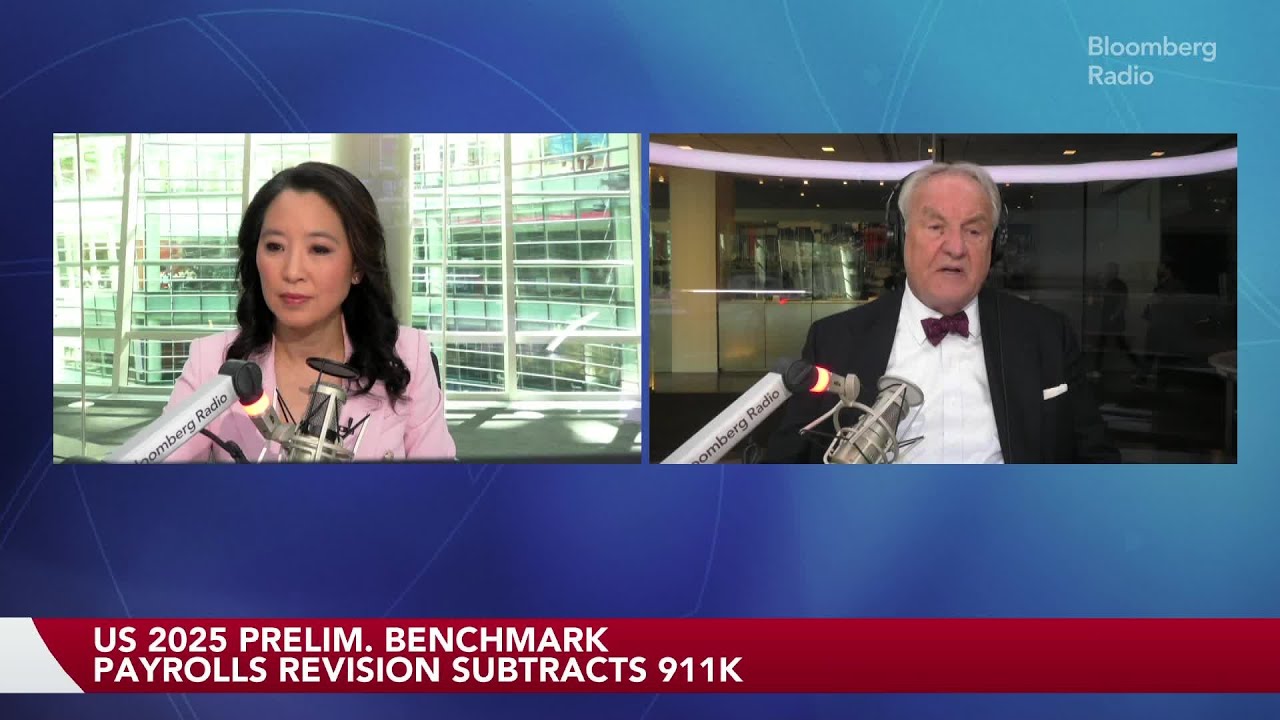
US Payrolls Estimated to Be 911K Lower Through March
Posted
September 9, 2025
Views
5,119
Likes
70
Comments
13
Engagement
1.62%
September 9, 2025
5,119
70
13
1.62%
Every word spoken in this episode is indexed. Type any phrase to jump straight to the moment it was said.
Type any word or phrase that may have been spoken. Click a result to seek the player to that exact moment.
Try a name, a topic, or a quoted line
See what was published immediately before and after this episode.
 2:34Now Playing
US job growth was far less robust in the year through March than previously reported, adding to mounting pressure on the Federal Reserve to lower interest rates.
The number of workers on payrolls will likely be revised down by a record 911,000, or 0.6%, according to the government’s preliminary benchmark revision out Tuesday. The final figures are due early next year.
Before the report, the government’s payrolls data indicated employers added nearly 1.8 million total jobs in the year through March on a non-seasonally adjusted basis, or an average of 149,000 per month. The revision showed average monthly job growth was roughly half that.
The Bureau of Labor Statistics adjustment indicates the labor market slowdown in recent months followed an extended period of more moderate job growth that may lay the groundwork for a series of interest-rate cuts beginning next week. Fed Chair Jerome Powell recently acknowledged risks to the job market have increased, and two of his colleagues preferred to lower borrowing costs in July.
Traders widely expect central bankers to cut rates at the conclusion of their two-day meeting Sept. 17. Treasury yields rose while the S&P 500 reversed earlier gains.
The labor market “was materially weaker than the BLS initially estimated in the year to March 2025, giving the Fed another reason to lower rates next week,” Sal Guatieri, senior economist at BMO Capital Markets, said in a note.
Payrolls were marked down in nearly every industry and most states. Combined payrolls at wholesale and retail establishments led the downward revision, followed by leisure and hospitality. Professional and business services as well as manufacturing were also notably marked down.
While benchmark revisions are carried out every year, they’ve garnered added attention this year with investors and Fed watchers looking for any signs that the labor market may be slowing faster than previously thought.
Political Ire
Sizable adjustments to monthly job data sparked outrage at the White House and led to President Donald Trump’s dismissal of the head of the BLS in August. Last year, he took aim at former President Joe Biden, calling into question the integrity of his administration and its economic record after a similarly large downward revision in the 2024 preliminary benchmark revision.
The final 2024 revision was ultimately not as severe as the preliminary suggested, though it was still the largest since 2009.
“Today, the BLS released the largest downward revision on record proving that President Trump was right: Biden’s economy was a disaster and the BLS is broken,” White House Press Secretary Karoline Leavitt said in a statement. “This is exactly why we need new leadership to restore trust and confidence in the BLS’s data.”
While Trump has been critical of revisions, both the monthly and benchmark adjustments are part of a routine process of updating estimates as more data become available. Adjustments have been bigger than usual in recent years, which some economists attribute to unique post-pandemic dynamics.
“Today’s massive downward revision gives the American people even more reason to doubt the integrity of data being published by BLS,” Labor Secretary Lori Chavez-DeRemer said in a statement. The Labor Department oversees the BLS.
“Considering these reports are the foundation of economic forecasts and major policy decisions, there is no room for such a significant and consistent amount of error. It’s imperative for the data to remain accurate, impartial, and never altered for political gain,” she added.
While the revision in and of itself is large, it’s not so big in the context of the broader economy, said Joseph Brusuelas, chief economist at RSM US LLP.
“In an economy where 163.3 million individuals are employed, a downward revision of 911,000 distributed over the space of twelve months is not that large from a quantitative point of view,” Brusuelas said in a note. “We will not know the monthly distribution of those downward revisions until February 2026.”
--------
Watch Bloomberg Radio LIVE on YouTube
Weekdays 7am-6pm ET
Follow us on X
Subscribe to our Podcasts:
Bloomberg Daybreak
Bloomberg Surveillance
Bloomberg Intelligence
Balance of Power
Bloomberg Businessweek
Listen on Apple CarPlay and Android Auto with the Bloomberg Business app:
Apple CarPlay
Android Auto
Visit our YouTube channels:
Bloomberg Podcasts
Bloomberg Television
Bloomberg Originals
Sentinel Indexing in Progress
Metadata and chapters are available. Claim extraction for this episode is pending.
All video content is delivered via YouTube embedded players in accordance with the YouTube Terms of Service. Sentinel provides research tools that promote discovery and accountability across political media.