Reading Through History
@readingthroughhistor·106K subscribers·437 videos
What is 1984?
Posted
February 28, 2017
Views
17,405
Likes
392
Comments
42
Engagement
2.49%
February 28, 2017
17,405
392
42
2.49%
Every word spoken in this episode is indexed. Type any phrase to jump straight to the moment it was said.
Type any word or phrase that may have been spoken. Click a result to seek the player to that exact moment.
Try a name, a topic, or a quoted line
 4:59Now Playing
For a teaching unit covering Orwell, click here
The following video provides a brief history of the novel "Nineteen Eighty-Four", including a plot summary, as well as how it was received by critics upon its initial release, and the impact it has had on society.
***
Like our Facebook page
Follow us on Instagram
Follow us on Twitter
Check out our TpT store
Check out our website
Copyright Disclaimer Under Section 107 of the Copyright Act 1976, allowance is made for fair use for purposes such as criticism, comment, news reporting, teaching, scholarship, and research. Fair use is a use permitted by copyright statute that might otherwise be infringing. Non-profit, educational, or personal use tips the balance in favor of fair use.
***
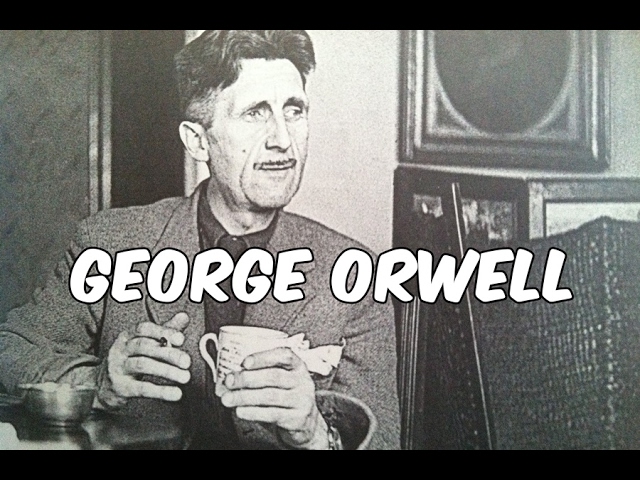
Author George Orwell first published the novel Nineteen Eighty-Four in the year 1949. What was this book about? How is it regarded today?
The setting for Nineteen Eighty-Four (also titled 1984) is a fictional location known as Airstrip One (present-day Great Britain) in a dystopian future. The protagonist of the story is Winston Smith, who works for the Ministry of Truth. His job requires him to revise history by altering records and editing photographs in an effort to eliminate the memory of people who were disloyal to the government.
He lives in a society which is governed by a political ideology known as Ingsoc (short for English Socialism). This society is completely controlled by “Big Brother,” a name used to describe the leader of Winston’s fictional nation, Oceania. The people of Oceania are under constant surveillance. Each home is equipped with a “telescreen” which functions as a device that the government uses to spy on its citizens. Children in this society are also encouraged to report their parents for saying anything deemed disloyal to the government. These incidents are then reported to the Thought Police. Those detained by the Thought Police are either tortured, re-educated, or eliminated.
In this futuristic world, nearly the entire population of the world lives in poverty. Most of the buildings are in ruins, with the only nice structures being government complexes. Hunger and diseases are common amongst the poorest of citizens who are referred to as the “proles” (short for proletariat). Proles are kept sedated with alcohol and other forms of cheap entertainment.
As the story commences, Winston becomes disenchanted with the world in which he lives. He begins to question the government and seek out like-minded individuals who oppose the ruling political class. He is eventually given a copy of a secret manuscript known as “The Book,” which thoroughly explains the true nature of their society. Winston is finally arrested by the Thought Police on suspicions of being a thought criminal.
Upon the novel’s release, Nineteen Eighty-Four was very well-received by critics. It was described as both frightening and depressing, yet highly original. Others described it as the most gripping political novel that had been written in nearly a decade.
The book’s impact on modern society could be regarded as profound. Many terms used in the novel have entered the everyday lexicon. Referring to the government as “Big Brother” is quite common in modern society. Other terms such as “doublethink,” “newspeak,” and “room 101” are also used on a conversational level. Additionally, the practice of placing the word “speak” at the end of words began with Nineteen Eighty-Four (for example, mediaspeak or coachspeak). Also, while the term itself is not used in the book, many people will use the phrase “Orwellian” to describe any aspect of government overreach that reminds them of the novel.
The novel has been presented on film twice and also twice as a radio drama. It is highly regarded as one of the best books ever written and has become required reading in many high school and college classes around the world.
Sentinel Indexing in Progress
Metadata and chapters are available. Claim extraction for this episode is pending.
All video content is delivered via YouTube embedded players in accordance with the YouTube Terms of Service. Sentinel provides research tools that promote discovery and accountability across political media.