United States Institute of Peace
@unitedstatesinstituteofpeace·110K subscribers·2.2K videos
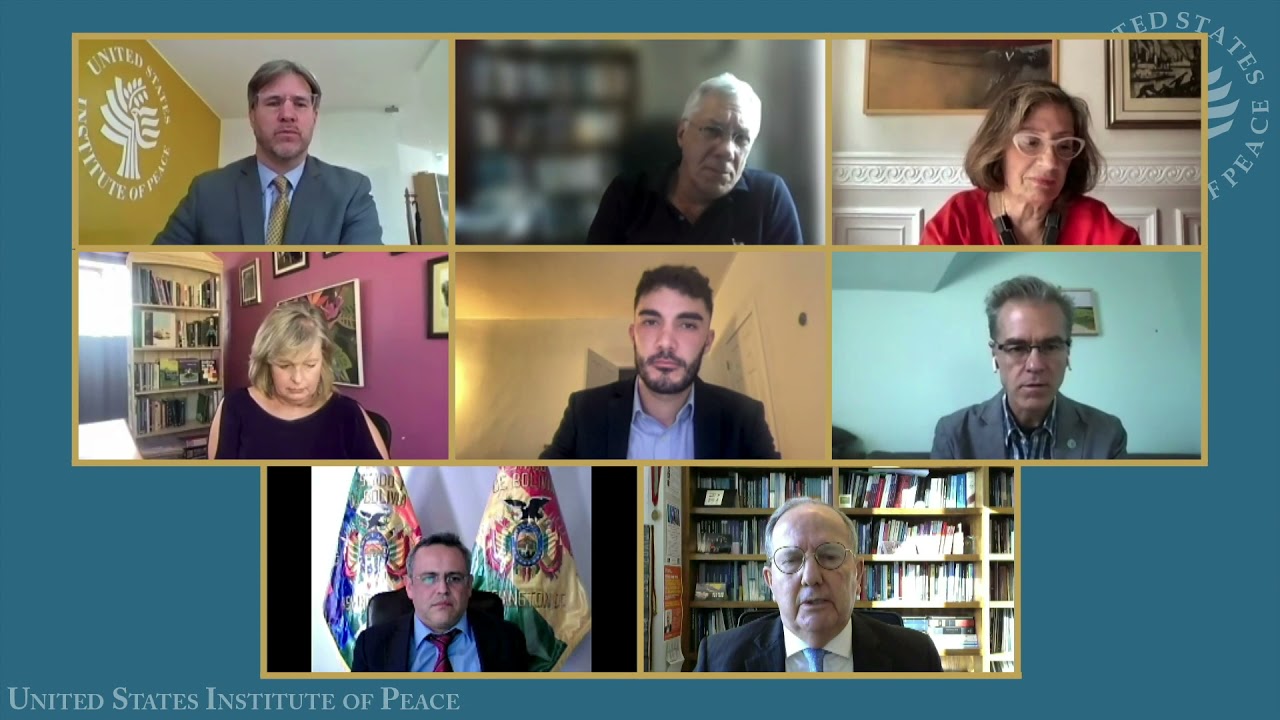
Bolivia’s Search for Justice and Reconciliation (English)
Posted
December 14, 2021
Views
344
Likes
4
Comments
2
December 14, 2021
344
4
2
1.74%
Every word spoken in this episode is indexed. Type any phrase to jump straight to the moment it was said.
Type any word or phrase that may have been spoken. Click a result to seek the player to that exact moment.
Try a name, a topic, or a quoted line
 2:07:19Now Playing
Bolivia’s October 2019 national elections convulsed the country as fraud allegations triggered widespread protests and social conflict. Facing a national police mutiny and a public warning from the military to step down, then-President Evo Morales resigned and fled Bolivia. Amid the turmoil, security forces backed the installation of legislator Jeanine Áñez as interim president and cracked down on demonstrations in the towns of Sacaba and Senkata, killing at least 20 people and injuring hundreds more. Preliminary reporting by the Inter-American Commission on Human Rights (IACHR) characterized the two episodes as massacres.
In December 2019, the IACHR and the Áñez government signed an agreement to create an Interdisciplinary Group of Independent Experts (GIEI) to investigate the acts of violence and human rights violations that roiled Bolivia in the wake of the 2019 elections. The GIEI experts planned to travel to Bolivia in February 2020, but impediments created by the Áñez government and the COVID-19 pandemic forced the experts to delay their field investigations until November 2020 after Luis Arce had been elected president.
The GIEI carried out its rigorous research with the resources and accompaniment of the IACHR and with financial support from the Mexican and U.S. governments, as well as from the Ford and Konrad Adenauer Foundations. In August 2021, the GIEI released its report and conclusions, including recommendations for much-needed reforms to strengthen a more credible national judicial response to this deeply polarizing period for Bolivians.
Please join USIP and WOLA for an in-depth discussion of the GIEI’s findings and an examination of how the GIEI’s recommendations can promote the kind of accountability, healing and common understanding across Bolivia’s political and identity divides that could ultimately prevent the repetition of the conflict, violence and human rights violations that marked the country’s 2019 electoral crisis. Take part in the conversation on Twitter with #BoliviaGIEI.
For more information about this event, please visit
To watch this event in Spanish, please visit
Connect with us!
Subscribe to our YouTube channel
Newsletters
The United States Institute of Peace is a national, nonpartisan, independent institute, founded by Congress and dedicated to the proposition that a world without violent conflict is possible, practical and essential for U.S. and global security. In conflict zones abroad, the Institute works with local partners to prevent, mitigate, and resolve violent conflict. To reduce future crises and the need for costly interventions, USIP works with governments and civil societies to build local capacities to manage conflict peacefully. The Institute pursues its mission by linking research, policy, training, analysis and direct action to support those who are working to build a more peaceful, inclusive world. Learn more about USIP
Sentinel Indexing in Progress
Metadata and chapters are available. Claim extraction for this episode is pending.
All video content is delivered via YouTube embedded players in accordance with the YouTube Terms of Service. Sentinel provides research tools that promote discovery and accountability across political media.