
Bloomberg News
@Bloomberg-News·2.8M subscribers·40.1K videos
Asia's Wealthiest Man Is Going Green But Still Gets Rich Off Oil
Posted
August 27, 2021
Views
197
August 27, 2021
197
Every word spoken in this episode is indexed. Type any phrase to jump straight to the moment it was said.
Type any word or phrase that may have been spoken. Click a result to seek the player to that exact moment.
Try a name, a topic, or a quoted line
You’re on August 27, 2021. Earlier episodes are to the left, later ones to the right — the row keeps loading as you go. Click any card to open it.
 Aug 27, 20212:21Now Playing
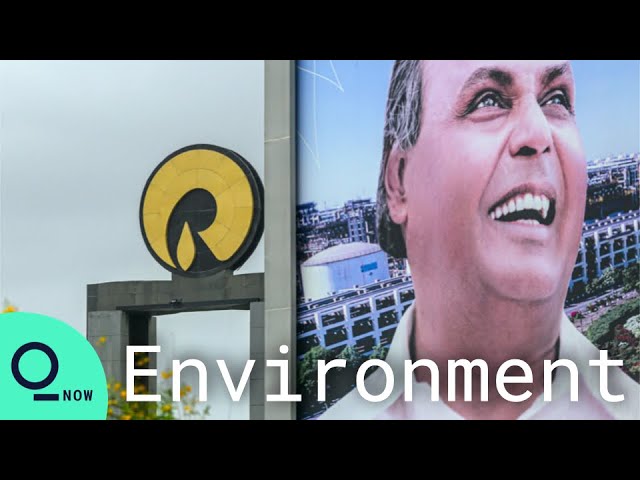
Along the Arabian Sea, the Indian city of Jamnagar is a money-making machine for Asia’s richest man, Mukesh Ambani, processing crude oil into fuel, plastics and chemicals. It’s also where the billionaire is making his newest bet: a $10 billion investment in green energy.
In a swath of arid land, to the city’s southwest, Ambani’s Reliance Industries Ltd., owns the world’s biggest oil refining complex. It’s a sprawling network of plants and pipelines that can process 1.4 million barrels of petroleum a day in an operation covering half the area of Manhattan. In fiscal 2021, Reliance generated about 45 million tons of carbon dioxide emissions from its own operations, which puts the company among the top such emitters in India, according to data on other companies tracked by Bloomberg. Much of that came from its Jamnagar refineries.
Next door, in a nod to a changing — and warming — world Ambani is now building factories that make more environmentally friendly products like solar panels, electrolyzers, fuel cells and batteries.
On the face of it, the new investment is a sharp pivot for a giant conglomerate whose fortunes have been linked to oil refining for decades. Yet even as Ambani, 64, touts the shift to less polluting options, crude’s byproducts will remain one of the biggest drivers of the $80 billion fortune that’s made him the world’s 12th richest man.
Reliance gets nearly 60% of its $73 billion in annual revenue from its oil-related business, which is so lucrative that it’s attracting other investors. The Middle Eastern energy firm Saudi Aramco is in discussions for the purchase of a roughly 20% stake in Reliance’s refining and chemicals business.
Ambani’s conglomerate is also investing in global expansion projects for the petrochemicals business that’ll last for decades. Even if its new energy operations take off, they will contribute only 10% of Reliance’s total earnings before interest, taxes, depreciation and amortization by fiscal 2026, while oil-to-chemicals will stay at about 33%, Sanford C. Bernstein analysts estimated in July.
That’s making Jamnagar a location that highlights a broader tension in the energy transition: While the world’s biggest fossil fuel companies are rushing to placate investors — and chase profits — by adding clean power sources, that doesn’t signal a quick retreat from polluting fuels. It’s a contrast playing out even as climate scientists escalate warnings about the fallouts of human-caused global warming.
M.V. Ramana, an energy policy scholar and professor at University of British Columbia, said it would be hard for Reliance to dissociate from fossil fuel businesses that create emissions.
“If you look at what Reliance’s trajectory has been, it is one of expansion of its fossil fuels business,” Ramana said. Shifting dramatically away from the more polluting oil-to-chemicals business is difficult “because it is going to affect their bottomline,” he said.
Reliance didn't respond to requests for comment. At its annual shareholders' meeting in June, Ambani acknowledged the need for change. “The age of fossil fuels, which powered economic growth globally for nearly three centuries, cannot continue much longer. The huge quantities of carbon it has emitted into the environment have endangered life on earth,'' he said. Reliance has said it will make its operations carbon neutral by 2035 with the help of projects that offset emissions.
There are also plans to arm the 7,500-acre Jamnagar refinery-and-petrochemicals complex with solar power, green hydrogen and carbon dioxide capture and usage technologies. To curb pollution, about 2,200 acres of land within the facility have been converted into a green pasture, growing mangoes, guavas and medicinal plants.
Subscribe to our YouTube channel
Subscribe to our newest channel Quicktake Explained
Bloomberg Quicktake brings you live global news and original shows spanning business, technology, politics and culture. Make sense of the stories changing your business and your world.
To watch complete coverage on Bloomberg Quicktake 24/7, visit or watch on Apple TV, Roku, Samsung Smart TV, Fire TV and Android TV on the Bloomberg app.
Have a story to tell? Fill out this survey for a chance to have it featured on Bloomberg Quicktake
Connect with us on…
Breaking News on YouTube
Sentinel Indexing in Progress
Metadata and chapters are available. Claim extraction for this episode is pending.
All video content is delivered via YouTube embedded players in accordance with the YouTube Terms of Service. Sentinel provides research tools that promote discovery and accountability across political media.