Big Think
@bigthink·8.8M subscribers·10.1K videos
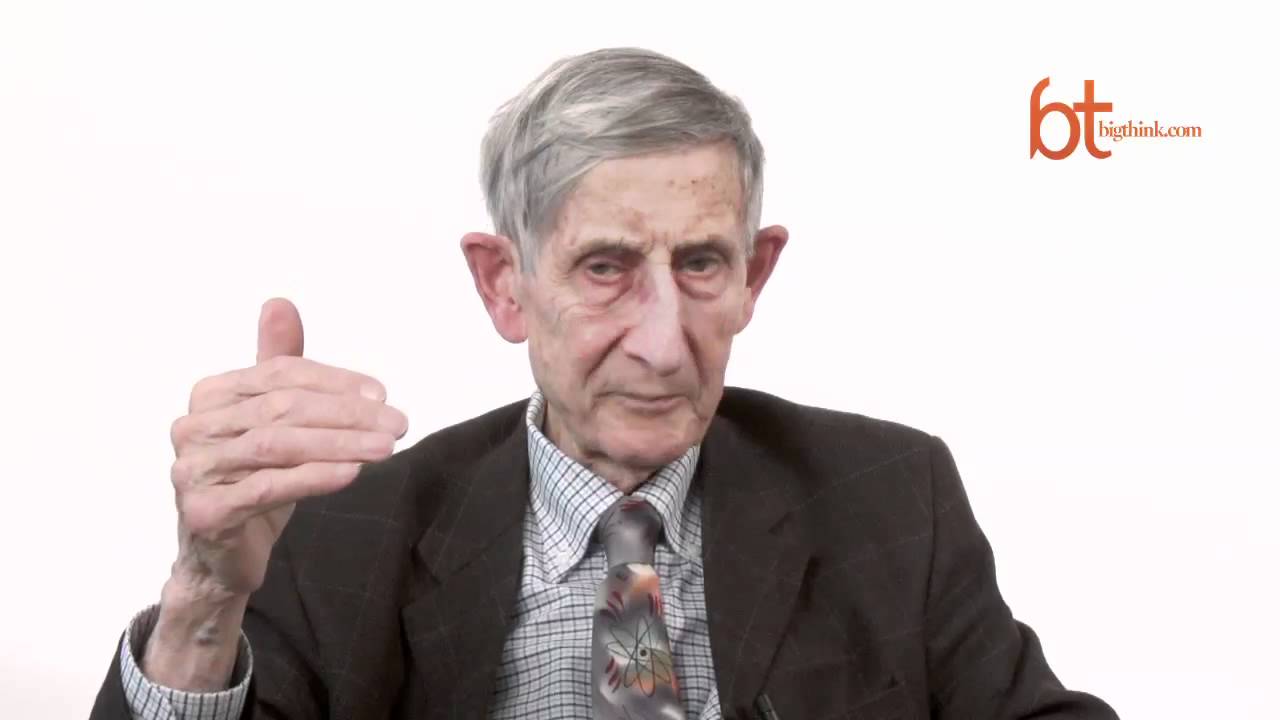
Could Science Make the 21st Century Worse Than the 20th? | Freeman J. Dyson | Big Think
Posted
April 24, 2012
Views
329
Likes
2
Engagement
0.61%
April 24, 2012
329
2
0.61%
Every word spoken in this episode is indexed. Type any phrase to jump straight to the moment it was said.
Type any word or phrase that may have been spoken. Click a result to seek the player to that exact moment.
Try a name, a topic, or a quoted line
 5:05Now Playing
Could Science Make the 21st Century Worse Than the 20th?
New videos DAILY
Join Big Think Edge for exclusive videos
----------------------------------------------------------------------------------
From WWI chemical warfare to nuclear weapons, Freeman Dyson thinks misguided science was “quite rightly” blamed for many 20th-century atrocities. What dangers could it pose for the future?
----------------------------------------------------------------------------------
Freeman J. Dyson:
Freeman J. Dyson is Professor Emeritus of Mathematical Physics and Astrophysics in the School of Natural Sciences at the Institute for Advanced Study in Princeton. He has taught as a professor at the Institute since 1953, prior to which he was a professor for two years at Cornell University. His work on quantum electrodynamics marked an epoch in physics, with the techniques he used in this domain forming the foundation for most modern theoretical work in elementary particle physics and the quantum many-body problem. He is also celebrated as an author on science and related topics; his books include "Disturbing the Universe" (1966), "Weapons and Hope" (1984), "The Scientist as Rebel" (2006), and "A Many-Colored Glass: Reflections on the Place of Life in the Universe" (2007).
----------------------------------------------------------------------------------
TRANSCRIPT:
Question: How did the physics community react after the dropping of the atomic bomb?
Freeman Dyson: Of course they talked about it incessantly. That was the main subject of conversation for many years and so people had very strong feelings about it on both sides and people who thought it was the greatest thing they'd ever done and people who thought it was just an unpleasant job and people who thought they should have never done it at all, so there were opinions of all kinds.
Question: How does the public, including public ignorance of science, affect scientists?
Freeman Dyson: Well it’s very hard to tell. I mean I grew up in England at a time when England was winning Nobel Prizes right and left. I mean it was amazing how many Nobel Prizes England was winning in chemistry and physics and biology and all the sciences and at that time the teaching of science in the schools was really lousy. I mean I experienced that myself. We learned almost nothing in school. Science was very unpopular. It was… I mean science was blamed for all the horrors of World War I, just as it’s blamed today for nuclear weapons and quite rightly. I mean World War I was a horrible war and it was mostly the fault of science, so that was in a way a very bad time for science, but on the other hand we were winning all these Nobel Prizes. Well since then of course the teaching of science in schools in England has improved tremendously and the number of Nobel Prizes has gone down and I think that that might even be connected. I don’t know, but I think it’s quite possible that the more science you teach kids in school the more it turns them off, so I don’t know. I mean you never can tell which way it will go.
Question: Are there any current technologies or areas of scientific inquiry that could have similarly terrible consequences?
Freeman Dyson: Indeed there are. Of course I mean it’s strange in a way that we had already we were scared of biological warfare in the ‘30s. I mean there was Aldous Huxley, wrote his novel Brave New World and started out with anthrax bombs, so we knew all about anthrax already in the ‘30s and in fact, we expected that. I mean when World War I… when World War II came along, which was when I was a teenager, we all expected we would have anthrax bombs and this kind of stuff. We thought it would be a biological war. Fortunately it wasn’t and, but it’s because the danger is still there and by some miracle we escaped all that, so you never can tell what it going to happen, but biology certainly could be even worse than physics and chemistry.
Question: What specific biotechnologies could pose a danger?
Freeman Dyson: Well germ warfare of course exists. There have been on a small scale… There have been, of course, a few people who got killed with anthrax right here in Princeton.
Question: Will humanity destroy itself, or will wisdom prevail?
Freeman Dyson: Well it’s always a mixture. We don’t know what’s… Some things go better than you expected, other things go worse, so I’m… I think the only sensible thing is just to wait and see and what I’m doing when I’m writing books - I’m not doing science so much anymore. Mostly I’m just writing books for the public, and so I try to describe for the public what the choices are, what they might have to expect in the future and so by warning people ahead of time maybe you have an effect.
Read the full transcript at
Sentinel Indexing in Progress
Metadata and chapters are available. Claim extraction for this episode is pending.
All video content is delivered via YouTube embedded players in accordance with the YouTube Terms of Service. Sentinel provides research tools that promote discovery and accountability across political media.