Daniel Davis Deep Dive
@danieldavisdeepdive·442K subscribers·4.9K videos
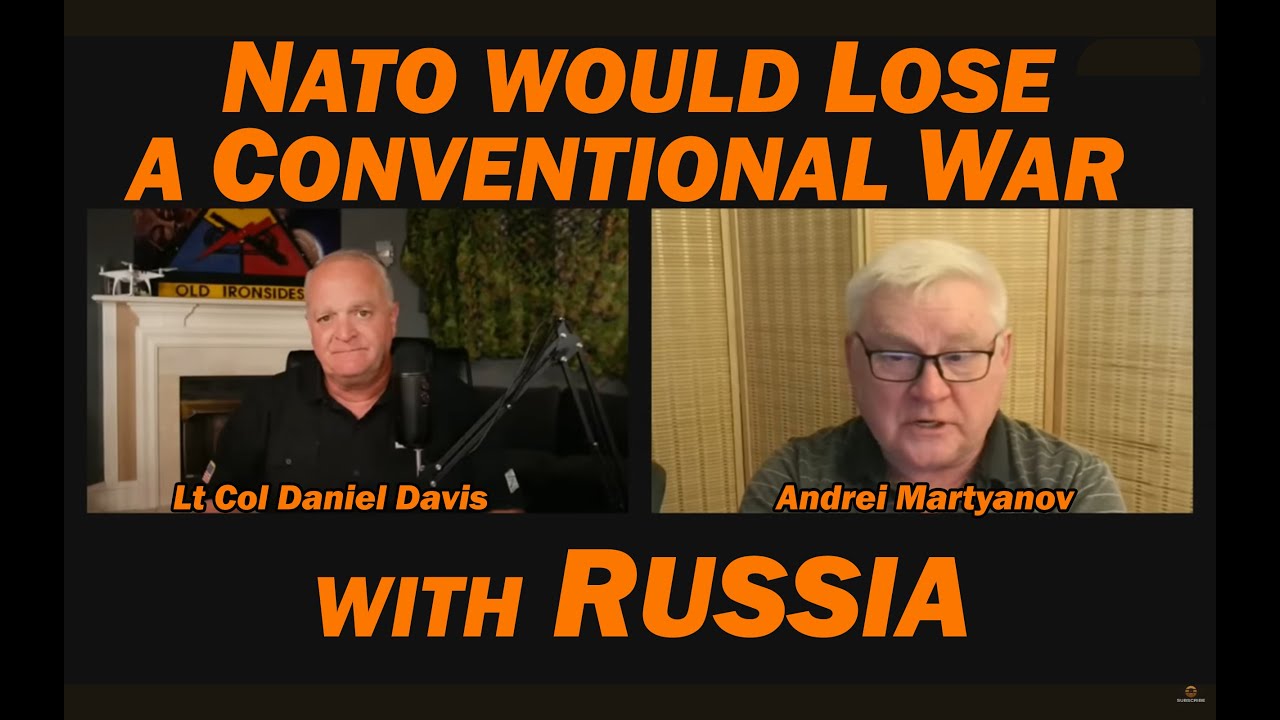
NATO Would Lose a Conventional War w/Russia - Andrei Martyanov & Lt Col Daniel Davis
Posted
October 6, 2025
Views
43,740
Likes
1,965
Comments
471
Engagement
October 6, 2025
43,740
1,965
471
5.57%
Every word spoken in this episode is indexed. Type any phrase to jump straight to the moment it was said.
Type any word or phrase that may have been spoken. Click a result to seek the player to that exact moment.
Try a name, a topic, or a quoted line
 31:49Now Playing
Daniel Davis Deep Dive Merch: Etsy store
Russia is preparing for the possibility of a large conventional clash and is operating on the strategic assumption that Europe is politically and militarily weak — so Moscow is planning accordingly (and believes it could inflict catastrophic damage if escalation occurs).
European weakness (political + military): European leaders (examples: Starmer, Macron) are politically vulnerable; publics are polarized and elites are described as geopolitically and militarily incompetent. Europe lacks combat-ready formations, effective air defenses, and the industrial capacity to rapidly scale wartime production.
Risk of provocation/false flags: The speaker claims Western actors (e.g., UK) might stage provocations or false-flag incidents to rally publics — actions that could spiral out of control and trigger escalation.
U.S.–Europe decoupling: Putin is portrayed as working (through opportunistic alignment with Trump-style U.S. policies) to isolate the U.S. from Europe militarily. U.S. supplies to Ukraine/Europe are said to have narrowed dramatically, reducing Western ability to sustain long-term conflict support.
Russian preparations & doctrine: Russia is building both conventional and strategic (including nuclear-capable) strike capabilities and follows doctrines (referenced “articles 26/27”) that envision decisive action against Western military-political leadership if conflict occurs.
Industrial advantage: Over the ~3+ years of the conflict, Russia has massively ramped production of long-range fires and air-defense munitions (speaker gives a rough order-of-magnitude example: ~131,000 air-defense missiles in ~1,315 days). The claim: Russia can sustain attrition much better than Europe.
Specific materiel example — “Terminator”: New Russian combat support vehicles (an unmanned-turret vehicle called “Terminator” in the discussion) are described as highly capable: unmanned turret, dual 30mm, anti-drone defenses, upgraded armor, latest ATGMs, netcentric systems — and improved in subsequent batches.
Attrition/conventional war outcome: In a conventional war of attrition, Europe (even with U.S. help) is judged unlikely to “win” because of production shortfalls, energy dependence, and insufficient ramp-up capability. Estimates given: without massive systemic change, Europe would need many years (speaker suggests 5–7 years or longer; possibly ~7 years) to reach sustainable production and force levels.
Energy vulnerability: Modern warfare requires energy; Europe is heavily dependent on hydrocarbons and cannot match Russia’s energy resources. The U.S. cannot fully substitute Europe’s energy needs quickly (insufficient LNG infrastructure), further weakening Western sustainment.
Bottom line / warning: The speaker warns that if large-scale conventional hostilities break out, the balance as described strongly favors Russia; escalation risks existential consequences for Europe. The overall tone is a strategic warning that Western political-military fragility combined with Russian preparation creates a dangerous imbalance.
Sentinel Indexing in Progress
Metadata and chapters are available. Claim extraction for this episode is pending.
All video content is delivered via YouTube embedded players in accordance with the YouTube Terms of Service. Sentinel provides research tools that promote discovery and accountability across political media.